Module 6: Stresses in Beams

Bridging structural analysis with physical design.
After determining the maximum internal shear forces (VV) and bending moments (MM) acting on a beam, the next step is calculating the resulting stresses that develop within the beam's physical cross-section. This is the crucial bridge between structural analysis (finding the abstract internal forces) and structural design (sizing the physical member to safely resist those forces without yielding or rupturing).

Key Concepts

Checklist

The Neutral Axis

When a simply supported beam bends downward under a load, the top fibers compress (shorten) and the bottom fibers stretch (tension). Somewhere between the compressed top and the stretched bottom, there is a horizontal plane where the material neither stretches nor compresses.
This specific plane of zero strain and zero normal stress is called the Neutral Axis (NA). For a homogeneous material acting elastically, the Neutral Axis always passes exactly through the centroid (center of gravity) of the cross-sectional area.

Flexural (Bending) Stress Formula

Calculating normal stress due to bending moments
The stress caused by an internal bending moment is called flexural stress or bending stress. It is a normal stress (acting perpendicular to the cross-section), just like axial tension or compression, but unlike a uniform axial load, bending stress varies linearly across the depth of the beam.
The general flexure formula calculates the normal bending stress (σ\sigma) at any vertical distance yy from the neutral axis:
σ=MyI \sigma = \frac{My}{I}
To design a safe beam, we must find the maximum flexural stress (σmax\sigma_{max}). Since stress increases linearly with distance from the NA, the maximum stress occurs at the extreme outer fibers. We denote the distance from the NA to this outermost fiber as cc:
σmax=McI \sigma_{max} = \frac{Mc}{I}
Where:
  • σ\sigma = Flexural stress at a specific point
  • MM = Internal bending moment at the section being analyzed
  • yy = Vertical distance from the neutral axis to the point of interest
  • cc = Maximum distance from the neutral axis to the extreme outermost fiber
  • II = Area Moment of Inertia of the entire cross-section about the neutral axis

Flexural Stress

The normal stress induced within a beam subjected to a bending moment. It varies linearly across the depth, reaching a maximum at the extreme outer fibers and zero exactly at the neutral axis.
Key Takeaways
  • Flexural stress (σ=My/I\sigma = My/I) varies linearly with distance yy from the neutral axis.
  • Maximum flexural stress (σmax=Mc/I\sigma_{max} = Mc/I) always occurs at the extreme outer fibers (top or bottom).

Assumptions of the Flexure Formula

Euler-Bernoulli Beam Theory
The flexure formula σ=MyI\sigma = \frac{My}{I} is derived based on several critical assumptions, known collectively as the Euler-Bernoulli beam theory:
  • Plane sections remain plane and perpendicular to the longitudinal axis after bending.
  • The material is homogeneous and isotropic.
  • The modulus of elasticity is constant in tension and compression.
  • The beam is initially straight and has a uniform cross-section.
  • Loads act within the plane of symmetry (no twisting).
Key Takeaways
  • The flexure formula rests on the assumption that plane cross-sections remain plane during pure bending (Euler-Bernoulli beam theory).

Advanced Beam Scenarios

Unsymmetrical bending and composite members
The flexure formula (σ=McI\sigma = \frac{Mc}{I}) introduced earlier is highly useful, but it relies on two very strict geometric assumptions:
  1. The beam cross-section is symmetrical about the axis of bending.
  2. The beam is made entirely of one uniform, homogeneous material.
When these conditions are violated, we must apply advanced stress analysis techniques.

Unsymmetrical Bending

If a beam cross-section is completely asymmetrical (like an unequal leg angle, a Z-section, or a channel section loaded outside its shear center), or if the applied load does not pass through an axis of symmetry, the beam will undergo unsymmetrical bending.
In pure symmetrical bending, the neutral axis is perfectly horizontal and the beam simply deflects downwards. However, in unsymmetrical bending, the member simultaneously bends downwards and twists laterally (sideways). The true neutral axis becomes inclined at an angle to the horizontal cross-section.
To determine the true bending stresses at any point (y,zy, z) on an unsymmetrical section under moments MyM_y and MzM_z, engineers must use the generalized, expanded flexure formula involving the product of inertia (IyzI_{yz}):
σ=(MyIz+MzIyz)y+(MzIy+MyIyz)zIyIzIyz2 \sigma = \frac{-(M_y I_z + M_z I_{yz})y + (M_z I_y + M_y I_{yz})z}{I_y I_z - I_{yz}^2}

Composite Beams

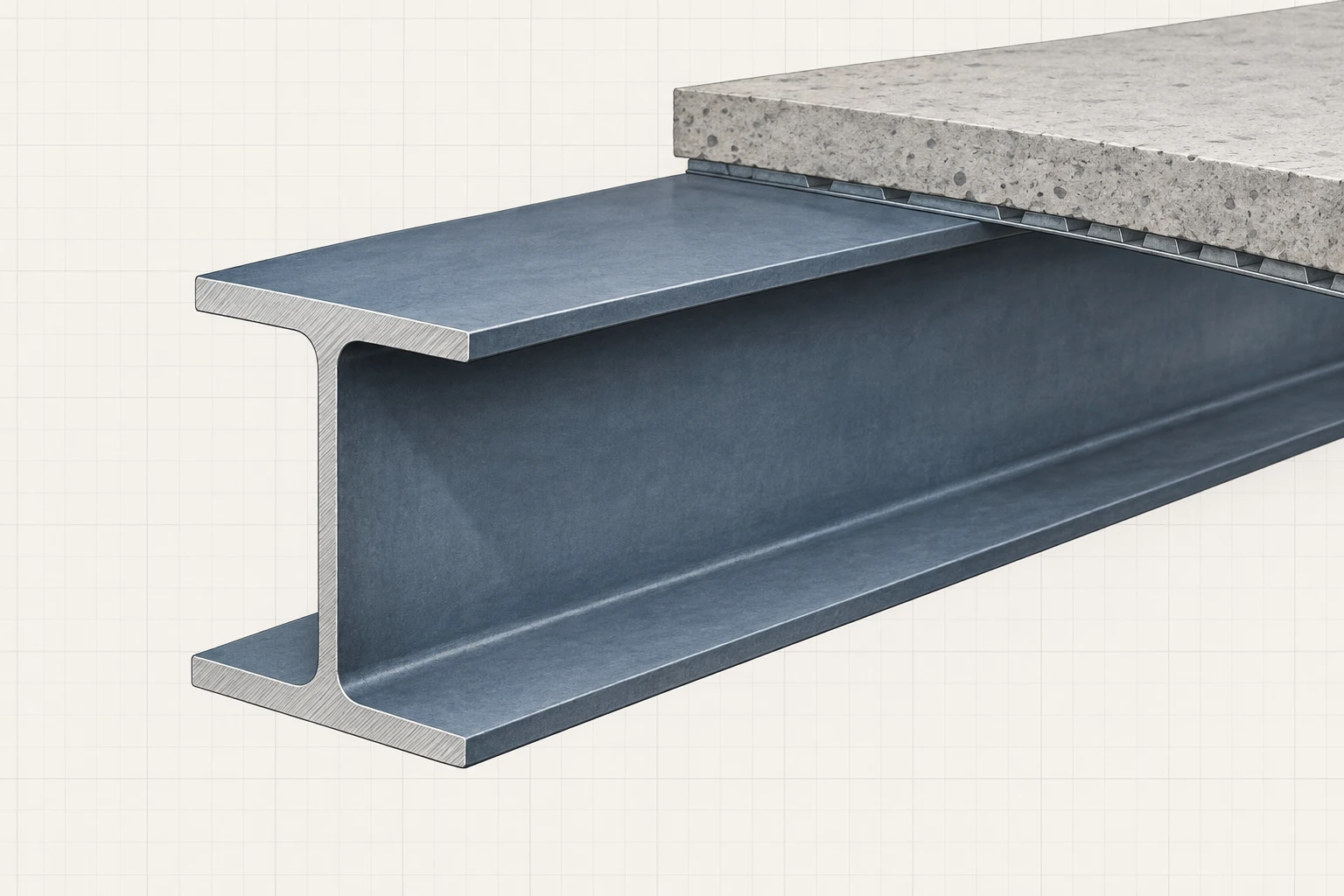
Many architectural members are constructed by permanently bonding two completely different materials together to leverage their individual strengths (e.g., a timber joist reinforced with a steel flitch plate, or a concrete slab poured over steel decking). These are composite beams.
Because the two materials have different Moduli of Elasticity (E1E_1 and E2E_2), they do not behave uniformly under load. A steel plate will carry significantly more stress than an identically sized piece of wood because steel is much stiffer.
To apply the standard flexure formula to a composite beam, we must mathematically convert the entire cross-section into a single, homogeneous, imaginary material. This is done using a modular ratio (nn):
n=EstrongEweak n = \frac{E_{strong}}{E_{weak}}
We then multiply the width (but not depth) of the stronger material by nn to create an equivalent "transformed" cross-section entirely made of the weaker material. We can then calculate the transformed section properties (II, ybary_{bar}) and apply σ=McI\sigma = \frac{Mc}{I} to find the true stresses.
Key Takeaways
  • Unsymmetrical bending occurs when loads are not aligned with a principal axis, causing simultaneous bending and lateral twisting.
  • Composite beams use different materials bonded together, requiring a modular ratio (n=E1/E2n = E_1/E_2) to create an equivalent transformed section for stress analysis.

Section Modulus

A geometric measure of bending strength
To simplify the iterative process of beam design, the geometric properties of a cross-section (Moment of Inertia II and extreme fiber distance cc) are often combined into a single ratio defined as the Section Modulus (SS).
The Section Modulus directly quantifies the bending strength of a specific geometric shape, independent of the material it is made from.
S=Ic S = \frac{I}{c}
Substituting SS back into the flexure formula, the maximum flexural stress equation simplifies significantly to:
σmax=MS \sigma_{max} = \frac{M}{S}

Section Modulus

A geometric property for a given cross-section used extensively in the design of beams. It directly relates to the strength of a beam in bending; larger section moduli correspond to geometrically stronger, stiffer beams.

Important

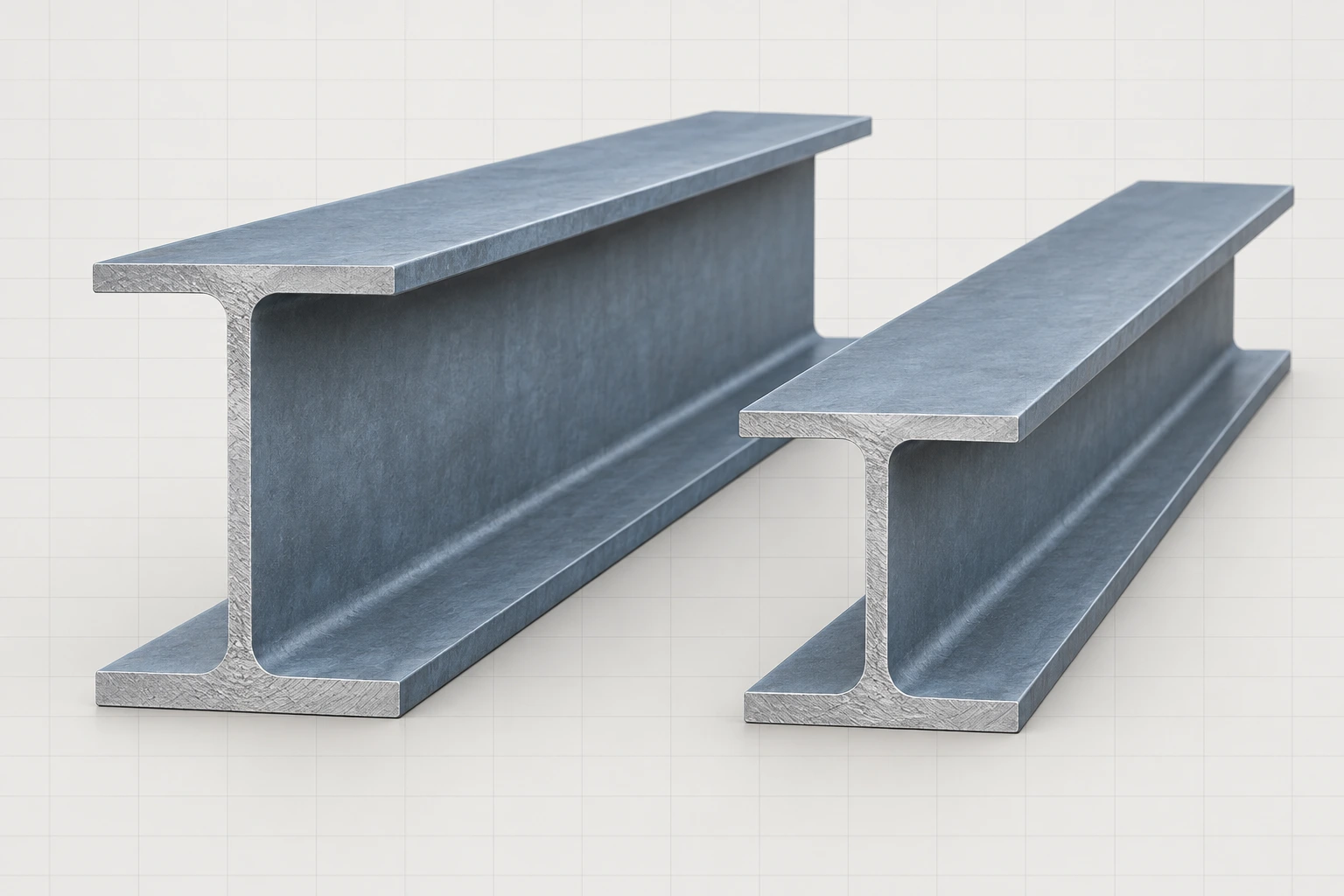
In structural design codes (like the AISC Steel Construction Manual), standard steel shapes (like W-beams or I-beams) are cataloged by their Section Modulus. An engineer calculates the required SS (RequiredS=Mmax/σallowableRequired S = M_{max} / \sigma_{allowable}) and simply selects the lightest, most economical standardized beam from the manual that provides at least that much Section Modulus.

Flexural Stress Distribution

Beam Cross-Section

200mm
100mm
Compression
Tension

Stress Profile (Depth vs Stress)

Loading chart...
Moment of Inertia (II)
66.67 × 10⁶ mm⁴
Section Modulus (SS)
666.67 × 10³ mm³
Max Flexural Stress (σmax\sigma_{max})
22.50 MPa
Key Takeaways
  • Section Modulus (S=I/cS = I/c) simplifies bending calculations (σmax=M/S\sigma_{max} = M/S).
  • It is the primary geometric property used to quickly select appropriately sized commercial beams.

Horizontal/Longitudinal Shear Stress

Shear resistance along the length of the beam
While bending moments cause normal stress, shear forces (VV) cause shear stress (τ\tau).
When a beam bends, the horizontal layers of fibers tend to slide past one another. Think of bending a deck of cards; the cards slide horizontally against each other. In a solid beam, the material's cohesive strength resists this sliding, creating internal horizontal (longitudinal) shear stress.
The general shear formula for beams is:
τ=VQIb \tau = \frac{VQ}{Ib}
Where:
  • τ\tau = Shear stress at a specific horizontal layer
  • VV = Internal vertical shear force at the cross-section
  • QQ = First moment of area of the portion of the cross-section above (or below) the layer where shear is being evaluated, taken about the neutral axis
  • II = Moment of inertia of the entire cross-section
  • bb = Width of the cross-section exactly at the horizontal layer where shear is being evaluated

Note

Unlike flexural stress which is maximum at the outer edges, horizontal shear stress is typically maximum exactly at the neutral axis (where QQ is largest) and is exactly zero at the extreme outer top and bottom fibers (where Q=0Q=0).
Key Takeaways
  • Horizontal shear stress (τ=VQ/Ib\tau = VQ/Ib) develops internally to resist layers sliding past one another during bending.
  • Unlike bending stress, horizontal shear stress is typically maximum at the neutral axis and zero at the extreme fibers.
  • For rectangular beams, a shortcut formula τmax=3V/2A\tau_{max} = 3V / 2A can be used.

Shear Flow

Designing fasteners for built-up sections
Many structural members are not solid pieces of material but are "built-up" from smaller components (like an I-beam constructed from three steel plates welded together, or a box beam made of glued plywood boards).
To ensure these separate pieces act together as a single solid beam, we need to design the fasteners (nails, bolts, screws, or welds) connecting them. We use the concept of shear flow (qq), which represents the horizontal shear force acting per unit length along the longitudinal axis of the beam.
q=VQI q = \frac{VQ}{I}
Once qq is known (in N/mmN/mm or lb/inlb/in), an engineer can determine how many nails or welds are required per inch to safely transfer that shear force between the built-up components.

Shear Flow

The gradient of a shear stress through a body, representing the internal shear force acting per unit length along the longitudinal axis of a beam. It is the critical metric for analyzing and designing the connections in built-up or composite beams.
Key Takeaways
  • Shear flow (q=VQ/Iq = VQ/I) is the shear force per unit length along the beam.
  • It is used specifically to design the spacing and capacity of fasteners (nails, bolts, welds) in built-up composite beams.

Design for Flexure and Shear

Practical application of flexural and shear theory in structural design
The primary objective in designing structural beams is to select a cross-section that can safely carry the applied loads without exceeding the allowable flexural (bending) stress (σallow\sigma_{allow}) or the allowable shear stress (τallow\tau_{allow}). Because bending typically governs the design of beams (except for very short, heavily loaded spans), the standard design procedure starts with flexure and is subsequently checked for shear.

Procedure

  1. Determine Maximum Moment: Draw the shear and bending moment diagrams for the beam to find the absolute maximum bending moment (MmaxM_{max}).
  2. Calculate Required Section Modulus: Using the allowable bending stress of the chosen material, calculate the minimum required section modulus (SreqS_{req}). Sreq=MmaxσallowS_{req} = \frac{M_{max}}{\sigma_{allow}}
  3. Select a Section: Choose a standard structural shape (like a W-shape steel beam or a specific timber size) from a properties table that has an SS equal to or greater than SreqS_{req}. For economical design, choose the lightest section that meets this requirement.
  4. Check for Shear: After selecting a section, calculate its maximum horizontal shear stress (τmax=VQIb\tau_{max} = \frac{V Q}{I b} or the simplified formulas for specific shapes) using the maximum shear force (VmaxV_{max}) from the shear diagram. Verify that τmaxτallow\tau_{max} \le \tau_{allow}. If it fails the shear check, a heavier section must be chosen.
  5. Check Deflection: Ensure the beam's maximum deflection under service loads does not exceed code-specified limits (e.g., L/360L/360 for floors).

Important

When selecting a beam section based on SreqS_{req}, always prioritize the section modulus (SS), but remember that the weight of the beam itself is a dead load. If the selected beam is very heavy, you may need to recalculate MmaxM_{max} including the beam's self-weight to ensure your selected section is still adequate.
Key Takeaways
  • Beam design begins by finding MmaxM_{max} and calculating Sreq=Mmax/σallowS_{req} = M_{max} / \sigma_{allow}.
  • After selecting a trial section based on flexure, you must check it for shear (τmaxτallow\tau_{max} \le \tau_{allow}) and deflection to finalize the design.

Limitations of the Flexure Formula

When is σ=My/I\sigma = My/I valid?

Assumptions and Limitations

The flexure formula (σ=My/I\sigma = My/I) is a cornerstone of structural mechanics, but it relies on several critical assumptions that dictate its limitations:
  1. Plane sections remain plane: The cross-section of the beam remains flat before and after bending.
  2. Linear Elasticity: The material must behave linearly and elastically, obeying Hooke's Law. If the stress exceeds the proportional limit, the formula is invalid (yielding plastic bending).
  3. Homogeneous Material: The material must have the same Modulus of Elasticity (EE) in tension and compression.
  4. Straight Beam: The beam must be initially straight. For curved beams (like crane hooks), a different, hyperbolic stress distribution formula is required.
Key Takeaways
  • The flexure formula σ=My/I\sigma = My/I is strictly valid only in the linear elastic range of the material.
  • It assumes plane sections remain plane and is inaccurate for initially curved beams or plastic deformation.