Safety and Ethics in Civil Engineering
Learning Objectives
- State and explain the seven Fundamental Canons of the PICE Code of Ethics.
- Connect public welfare, competence, truthfulness, conflicts of interest, fair competition, professional integrity, and continuing development to everyday civil engineering decisions.
- Distinguish technical competence from legal authority to perform a regulated professional service.
- Explain responsible charge, truthful representation of qualifications, and the ethical meaning of signing and sealing professional documents.
- Recognize common ethical failures involving falsification, bribery, conflicts, confidentiality, unsafe instructions, and "signing for others."
- Explain the Philippine construction occupational safety and health framework using RA 11058, applicable DOLE rules, and the Construction Safety and Health Program.
- Distinguish hazards from risks and apply the Hierarchy of Controls before relying on personal protective equipment.
- Use a structured ethical decision process when technical, legal, client, employer, and public-welfare duties conflict.
Engineering Ethics
Engineering ethics is the body of professional principles and duties that guides engineering judgment and conduct, especially where public welfare, technical uncertainty, law, client or employer interests, professional responsibility, and the consequences of engineering decisions interact.
Conflict of Interest
A conflict of interest exists when a personal, financial, professional, organizational, or other interest could improperly influence, or reasonably appear to influence, an engineer's independent professional judgment or loyalty.
Hazard
A hazard is a source, condition, activity, material, or situation with the potential to cause injury, illness, death, property damage, environmental harm, or another adverse consequence.
Risk
Risk is the possibility and consequence of harm arising from a hazard, commonly considered through factors such as likelihood, severity, exposure, and uncertainty.
Near Miss
A near miss is an unplanned event that caused no injury or damage but had the potential to do so. Near misses are valuable warning signals because they reveal weaknesses before a more serious event occurs.
Fundamental Principles of the Civil Engineering Code of Ethics
PICE states that civil engineers uphold and advance the integrity, honor, and dignity of the profession by:
- using their knowledge and skill for the enhancement of human welfare and the environment;
- being honest and impartial and serving with fidelity the public, their employers or employees, and clients;
- striving to increase the competence and prestige of the civil engineering profession; and
- supporting the professional and technical societies of their disciplines.
These principles provide the broad ethical foundation from which the seven Fundamental Canons operate.
The Seven Fundamental Canons
PICE's published Code of Ethics provides the following professional duties:
- Public welfare and sustainability: Civil Engineers shall hold paramount the safety, health and welfare of the public and shall strive to comply with the principles of sustainable development in the performance of their duties.
- Competence: Civil Engineers shall perform services only in areas of their competence.
- Truthful public statements: Civil Engineers shall issue public statements only in an objective and truthful manner.
- Faithful service and conflicts: Civil Engineers shall act in professional matters for each employer or client as faithful agents or trustees, and shall avoid conflicts of interest.
- Merit and fair competition: Civil Engineers shall build their professional reputation on the merit of their services and shall not compete unfairly with others.
- Honor and integrity: Civil Engineers shall act in such a manner as to uphold and enhance the honor, integrity, and dignity of the civil engineering profession.
- Continuing professional development: Civil Engineers shall continue their professional development throughout their careers, and shall provide opportunities for the professional development of those civil engineers under their supervision.
Canon 1: Public Welfare Is Paramount
Public welfare is not limited to preventing structural collapse. It includes the foreseeable safety, health, mobility, environmental, resilience, and infrastructure consequences of engineering decisions.
Examples of Canon 1 duties include:
- refusing to approve a knowingly unsafe deviation;
- escalating a serious defect or imminent danger rather than concealing it;
- communicating uncertainty when the available evidence is incomplete;
- considering workers, occupants, road users, neighboring properties, downstream communities, and future operators;
- preserving required safety margins despite schedule or cost pressure; and
- considering sustainability without using environmental claims to excuse noncompliance with mandatory safety requirements.
Client Loyalty Does Not Override Public Safety
An engineer may owe contractual and professional duties to a client or employer, but those duties do not justify falsifying data, concealing a known serious danger, violating mandatory requirements, or approving work that the engineer knows is unsafe. Canon 4 must be read together with Canon 1.
Canon 2: Competence Has Technical and Legal Dimensions
Competence requires more than possession of a professional license.
A civil engineer should consider:
- education and technical foundation;
- relevant experience and supervision;
- familiarity with the applicable codes, standards, methods, and hazards;
- ability to recognize limitations and seek specialist assistance;
- ability to independently evaluate software or delegated work; and
- the legal authority to perform the regulated professional service.
Technical capability does not automatically create a legal right to prepare, sign, or seal documents assigned by law to another regulated profession.
Professional Boundaries Are an Ethics Issue
Respecting professional scope is part of competent and honorable practice. Under the current Philippine framework, the fact that a civil engineer understands architectural drafting does not authorize that engineer to prepare, sign, or seal regulated architectural documents. Likewise, an architect's architectural role does not eliminate the civil engineer's responsibility for civil/structural documents assigned to civil engineering under the applicable building rules.
Canon 3: Objective and Truthful Professional Communication
Truthfulness applies to more than public speeches.
Engineers should not:
- falsify laboratory, survey, inspection, quantity, progress, or design records;
- omit material limitations in a way that makes a report misleading;
- exaggerate qualifications, licenses, project roles, or technical experience;
- present preliminary or unverified results as final facts;
- invent references, calculations, test results, or code provisions; or
- allow marketing, advocacy, or employer pressure to distort technical conclusions.
When expressing a professional opinion, identify important assumptions, uncertainty, data limitations, and conflicts that could affect interpretation.
Canon 4: Faithful Agency and Conflict Management
A civil engineer should serve clients and employers faithfully while preserving independent professional judgment.
Common conflict situations include:
- undisclosed financial interests in a supplier or contractor;
- accepting compensation from multiple parties on the same matter without required disclosure and agreement;
- reviewing one's own disputed work while pretending to be an independent evaluator;
- accepting gifts or benefits intended to influence technical approval;
- using confidential information for personal advantage; and
- allowing organizational loyalty to suppress a legitimate safety concern.
Conflicts should be identified early, disclosed when required, documented, and managed or avoided before they compromise judgment.
Canon 5: Reputation Should Rest on Merit
Professional competition should not depend on deception, bribery, malicious attacks, false credential claims, plagiarism, or improper inducements.
Civil engineers should compete through the quality, relevance, integrity, and value of their services. Technical criticism should focus on evidence, requirements, and engineering reasoning rather than personal attacks.
Canon 6: Integrity Includes Responsible Use of the Professional Seal
A professional signature and seal communicate responsibility. Ethical failures include:
- lending a professional seal or registration number;
- signing or sealing work not prepared under the level of supervision required by law;
- signing work outside lawful professional scope;
- approving calculations or drawings without understanding their basis;
- using another professional's credentials;
- knowingly allowing one's name to create a false impression of responsible charge; and
- concealing material errors discovered after issuance.
Professional responsibility cannot be outsourced merely by delegating drafting, computation, modeling, or checking tasks.
Signing for Others Is Not a Harmless Administrative Shortcut
A professional should never sign or seal a document merely because a contractor, employer, colleague, client, or permitting deadline requires a credentialed signature. Before accepting responsibility, verify lawful scope, competence, responsible charge, the completeness of the review, and the accuracy of the final professional document.
Canon 7: Continuing Development Is a Career-Long Duty
Professional competence decays if it is not maintained. Civil engineers should continually update their knowledge of:
- laws and professional regulations;
- structural, geotechnical, hydraulic, transportation, construction, and environmental practice;
- codes and standards;
- new materials and construction methods;
- hazards, resilience, and climate-related considerations;
- digital modeling, BIM, data, automation, and AI-assisted workflows; and
- communication, leadership, supervision, and ethical decision-making.
Engineers with supervisory roles also have an ethical responsibility to create meaningful learning and development opportunities for junior professionals.
Law and Ethics Work Together but Are Not Identical
A useful professional test is to ask four separate questions:
- Is it lawful? Determine the controlling statute, regulation, professional rule, permit requirement, and jurisprudence.
- Is it within my professional scope? Confirm that the service belongs to the profession and license being used.
- Am I actually competent? Determine whether education, experience, resources, and supervision are sufficient for the assignment.
- Is it ethically defensible? Consider public welfare, truthfulness, independence, conflicts, fairness, and professional integrity.
An action can be legal yet still ethically poor, and an engineer's belief that an action is ethically desirable does not authorize violation of a mandatory law.
Civil Engineering and Architecture: Ethical Coordination
The current Philippine legal framework requires discipline-specific responsibility on building projects.
The Supreme Court's 15 March 2023 decision in DPWH v. PICE / UAP v. PICE, G.R. Nos. 200015 and 205846 held that RA 9266 impliedly repealed RA 544 insofar as RA 544 permitted civil engineers to prepare, sign, and seal architectural documents.
The same building-permit framework recognizes civil engineers for civil/structural documents and architects for architectural documents, with other regulated professionals responsible for their respective disciplines.
Ethically sound coordination therefore means:
- respecting each profession's lawful document responsibility;
- coordinating interfaces without misrepresenting authorship;
- resolving conflicting technical requirements transparently;
- preserving clear revision and approval records; and
- refusing arrangements that use one professional's seal to bypass another profession's legal responsibility.
Occupational Safety and Health
Occupational safety and health is the systematic prevention and control of workplace hazards to protect workers and other affected persons from injury, illness, and death through legal compliance, hazard control, competent management, training, participation, and continuous improvement.
Philippine Construction OSH Framework
Construction safety should be understood as a system rather than as a single checklist or issuance.
Key parts include:
- Republic Act No. 11058, which strengthens compliance with Occupational Safety and Health Standards and provides penalties for violations;
- the Occupational Safety and Health Standards and applicable implementing rules and DOLE issuances;
- DOLE Department Order No. 13, Series of 1998, which provides construction-specific OSH requirements; and
- the project-specific Construction Safety and Health Program (CSHP) required for construction projects under applicable DOLE rules.
Current staffing, training, classification, documentation, and approval requirements should be verified from DOLE for the actual project and workforce.
RA 11058 Requires Active Hazard Management
RA 11058 requires employers, contractors, subcontractors, and persons managing or supervising covered work to address hazardous conditions, provide safety information and instruction, comply with OSH standards, provide appropriate safeguards and PPE where necessary, support worker participation, and prepare for emergencies. Workers also have duties to use safeguards properly, follow safety instructions, and report hazards.
Construction Safety and Health Program
A useful CSHP is specific to the project rather than copied from an unrelated job.
It should connect actual work activities to:
- organization, responsibilities, and safety personnel;
- hazard identification and risk controls;
- worker orientation, toolbox meetings, and training;
- incident, illness, and near-miss reporting and investigation;
- PPE and protective-device requirements;
- excavation, lifting, equipment, electrical, temporary works, work-at-height, and other high-risk controls;
- emergency preparedness and response;
- welfare, sanitation, health, and waste-management provisions;
- inspections, monitoring, documentation, and corrective action; and
- subcontractor and multi-employer coordination.
Safety Reporting and Correction
Follow the evidence chain from observation or near miss to objective reporting, assigned corrective action, implementation, and verification that the control remains effective.

Hierarchy of Controls
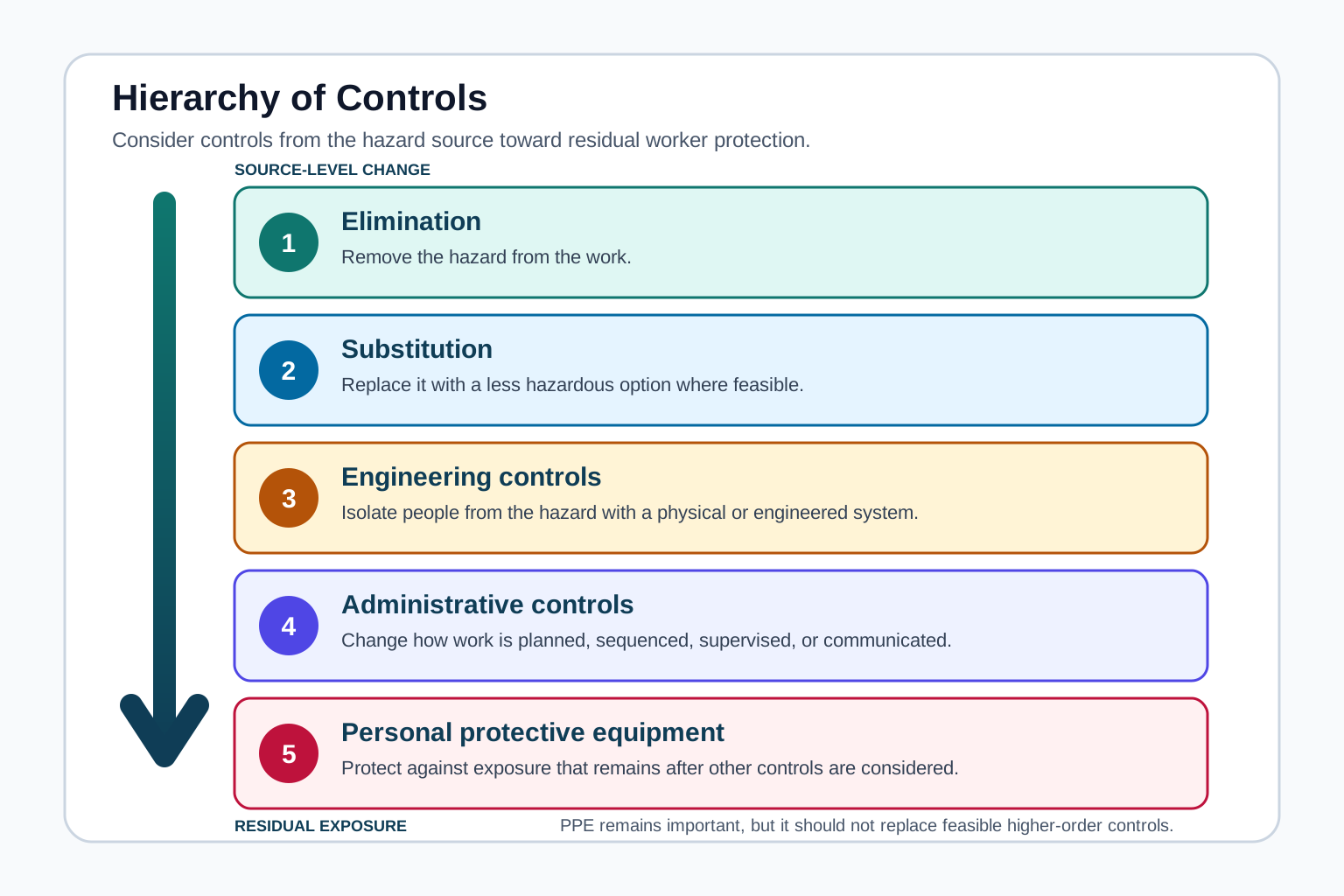
Risk controls should generally be considered from more reliable source-level controls toward controls that depend more heavily on human behavior.
- Elimination: remove the hazard entirely.
- Substitution: replace the hazardous material, process, or condition with a less hazardous alternative where feasible.
- Engineering controls: isolate people from the hazard through physical or engineered systems.
- Administrative controls: manage exposure through procedures, training, sequencing, permits, signage, supervision, and access restrictions.
- Personal protective equipment: reduce residual exposure using correctly selected and maintained wearable protection.
PPE is important, but it should not automatically be the first or only answer when higher-order controls are reasonably practicable.
Hierarchy of Controls
Read from source-level change toward residual exposure: remove or replace the hazard where feasible, isolate people with engineering controls, manage the work administratively, and use PPE for what remains.
Limits of Personal Protective Equipment
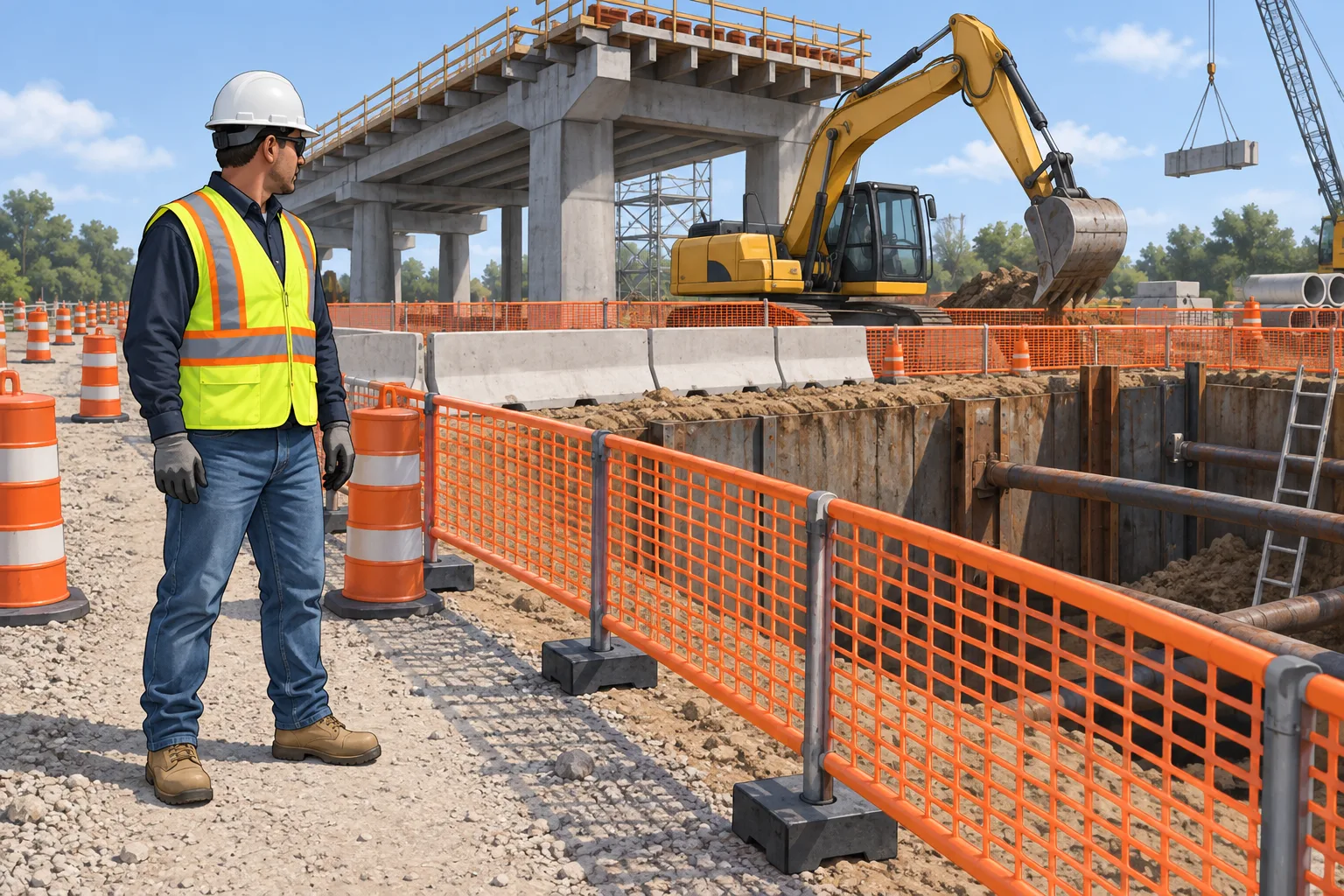
Compare wearable protection with source-level controls: PPE can reduce residual exposure, but it does not remove hazards such as falls, collapse, struck-by events, or electrical energy.
Interactive Safety and Ethics Simulation
Use the simulation below to compare ethical choices and hazard controls. For every scenario, identify the affected public or workers, the controlling professional duty, the strongest feasible hazard control, and the evidence that should be documented.
Interactive learning lab · 3 experiences
Safety and Ethics Learning Lab
Practice selecting stronger hazard controls, inspect common construction risk situations, and work through ethical decisions using evidence, professional duty, documentation, and appropriate escalation.
Hierarchy of Controls Challenge
Choose the strongest feasible control for common construction hazards and compare higher-order controls with administrative measures and PPE.
What to observe
PPE can be necessary but it is the last layer in the hierarchy. Stronger controls remove the hazard or physically separate people from it before relying on individual behavior or protective gear.
Unprotected floor edge
Workers repeatedly install components near an open elevated edge. Which option is the strongest primary control among the choices?
Common Construction Hazard Families
Civil engineers should recognize recurring hazard families even when a dedicated safety professional manages the formal OSH program.
- Work at height: falls, falling objects, access, anchorage, clearance, rescue, and incomplete edge protection.
- Excavation and trenching: collapse, groundwater, buried utilities, hazardous atmospheres, equipment loading, and unsafe access.
- Lifting and mobile equipment: suspended loads, crane capacity, rigging, ground support, blind spots, struck-by exposure, and exclusion zones.
- Temporary works: formwork, falsework, shoring, scaffolds, erection stability, bracing, and sequence-dependent instability.
- Electrical and stored energy: temporary power, damaged equipment, overhead lines, isolation, energization, and lockout requirements.
- Dust and hazardous substances: silica, fumes, chemicals, poor ventilation, skin contact, and respiratory exposure.
- Confined spaces: toxic or oxygen-deficient atmospheres, engulfment, restricted access, communication, and rescue.
- Fire and hot work: ignition sources, combustibles, gas cylinders, permits, fire watch, and emergency response.
Construction Hazard Awareness
Scan the work area by hazard family—height, excavation, equipment, temporary works, energy, substances, confined spaces, and hot work—before selecting controls.

Ethical Risk Areas in Engineering Practice
High-risk ethical situations include:
- approving substitutions without adequate technical review;
- falsifying inspection, laboratory, survey, progress, or quantity records;
- concealing known defects or nonconforming work;
- accepting work outside one's competence;
- practicing outside lawful professional scope;
- misrepresenting professional qualifications or project experience;
- copying calculations or specifications without verification;
- allowing schedule pressure to override mandatory safety requirements;
- bribery, kickbacks, gifts, or procurement manipulation;
- misuse of confidential information;
- discriminatory or retaliatory treatment of persons raising legitimate safety concerns; and
- relying on unverified software or AI output as though it were independently validated engineering evidence.
AI Does Not Assume Professional Responsibility
AI tools may assist with drafting, calculation setup, data processing, coding, summarization, or study, but they can produce false references, invalid assumptions, incorrect equations, misleading interpretations, or plausible-looking errors. The engineer remains responsible for independent verification, lawful use, confidentiality, and the final professional judgment.
Structured Ethical Decision Process
When a professional dilemma arises, use a repeatable process rather than relying only on intuition.
- Recognize the issue: identify the safety, competence, truthfulness, conflict, corruption, environmental, legal, or scope concern.
- Identify stakeholders: workers, public users, communities, owners, clients, employers, contractors, regulators, and future operators may be affected differently.
- Gather evidence: separate verified facts from assumptions and identify missing information.
- Identify controlling duties: review applicable law, regulation, code, contract, professional ethics, and organizational procedures.
- Define lawful alternatives: remove options that require unsafe or illegal action.
- Evaluate consequences and reversibility: consider severity, uncertainty, transparency, long-term effects, and whether harm can be corrected later.
- Consult appropriately: involve competent specialists, supervisors, legal counsel, ethics resources, or authorities when needed.
- Decide and document: record the concern, evidence, analysis, communication, decision, and required corrective action.
- Escalate proportionately: use higher internal or external channels when serious unresolved danger, legal duty, or professional responsibility requires it.
- Verify closure: confirm that the corrective action was actually implemented and remains effective.
Ethical Engineering Decision
Use the decision path to connect facts, applicable duties, lawful alternatives, consultation, documentation, proportionate escalation, and closure before accepting professional responsibility.

Ethical Safety Concern Escalation
Protect people first, establish the evidence and applicable duties, document the decision, and escalate unresolved danger through proportionate channels before verifying closure.
Recognize safety or integrity concern → Imminent harm or uncontrolled danger?; Imminent harm or uncontrolled danger? — Yes → Stop, isolate, warn, or otherwise protect people from immediate harm; Imminent harm or uncontrolled danger? — No → Gather objective facts, records, conditions, and affected work; Stop, isolate, warn, or otherwise protect people from immediate harm → Gather objective facts, records, conditions, and affected work; Gather objective facts, records, conditions, and affected work → Check law, code, contract, scope, competence, and public-welfare duties; Check law, code, contract, scope, competence, and public-welfare duties → Is the proposed action lawful, competent, and defensible?; Is the proposed action lawful, competent, and defensible? — Yes → Implement a proportionate corrective action; Is the proposed action lawful, competent, and defensible? — No → Consult and escalate through the required internal or external channel; Implement a proportionate corrective action → Was corrective action implemented and verified?; Was corrective action implemented and verified? — Yes → Document evidence, communication, decision, action, and remaining limitations; Was corrective action implemented and verified? — No → Implement a proportionate corrective action; Consult and escalate through the required internal or external channel → Document evidence, communication, decision, action, and remaining limitations; Document evidence, communication, decision, action, and remaining limitations → Close only when the risk is controlled and the record is complete
- Recognize safety or integrity concern: terminator
- Imminent harm or uncontrolled danger?: decision
- Stop, isolate, warn, or otherwise protect people from immediate harm: process
- Gather objective facts, records, conditions, and affected work: process
- Check law, code, contract, scope, competence, and public-welfare duties: process
- Is the proposed action lawful, competent, and defensible?: decision
- Implement a proportionate corrective action: process
- Consult and escalate through the required internal or external channel: process
- Was corrective action implemented and verified?: decision
- Document evidence, communication, decision, action, and remaining limitations: document
- Close only when the risk is controlled and the record is complete: terminator
Whistleblowing Requires Evidence and Proportionate Escalation
External reporting can be necessary when serious public danger or legal duties remain unresolved, but it should not be taught as an automatic first step that ignores fact-finding, documentation, confidentiality, organizational procedures, or applicable law. Public welfare remains paramount when serious danger persists.
Engineering Failure Cases as Ethics and Systems Lessons
Hyatt Regency walkway collapse, 1981: the disaster illustrates how a change to a critical connection can alter load paths and how inadequate change control, review, communication, and approval can convert a detail into a catastrophic system failure.
Tacoma Narrows Bridge collapse, 1940: the failure is a landmark in structural-aerodynamic interaction and aeroelastic flutter. It should not be reduced to the simplistic statement that ordinary vortex shedding merely matched the bridge's natural frequency.
The ethical lesson from failure cases is not simply to assign blame. Engineers should study how technical assumptions, design changes, communication, organizational processes, review systems, and professional responsibility interact.
Common Ethics Misconceptions
- "Ethics is mostly about bribery." Incorrect. Competence, public welfare, truthfulness, scope, responsible charge, documentation, conflicts, fairness, environmental responsibility, and continuing development are also central.
- "If the client accepts the risk, the engineer may ignore a mandatory requirement." Incorrect. Private agreement cannot automatically waive public-law duties.
- "If a licensed engineer signs it, the work becomes compliant." Incorrect. The signer must have lawful scope, competence, and genuine professional responsibility.
- "PPE is always the first safety control." Incorrect. Higher-order controls should be evaluated first.
- "No reported accidents proves the site is safe." Incorrect. Underreporting, weak near-miss reporting, and uncontrolled hazards can coexist with a temporary absence of injuries.
- "Software or AI is responsible for a wrong result." Incorrect. Professional users remain responsible for inputs, assumptions, verification, interpretation, and final decisions.
Ethics and Safety Check Before Professional Approval
- Identify who can be harmed if the decision is wrong.
- Confirm the applicable law, professional scope, code, standard, specification, and contract requirement.
- Confirm that you are competent and legally authorized to assume responsibility.
- Verify the technical basis, source data, assumptions, calculations, revisions, and limitations.
- Identify conflicts of interest and disclose or resolve them appropriately.
- Check whether a stronger hazard control is reasonably practicable.
- Communicate material risks and uncertainty truthfully.
- Document the review and decision.
- Refuse approval when lawful scope, competence, responsible charge, or minimum safety is not satisfied.
- Escalate unresolved serious safety or integrity concerns through appropriate channels.
Regulatory Currency
Professional regulation and occupational-safety requirements can change through legislation, implementing rules, Board resolutions, and DOLE issuances. This lesson reflects the framework verified for this revision on 15 September 2026. For actual professional work, verify the current official requirements that apply to the project, workplace, and professional service.
- The seven Fundamental Canons organize civil engineering ethics around public welfare, competence, truthfulness, faithful service, fair competition, integrity, and continuing development.
- Competence requires both actual technical capability and respect for the legal limits of professional practice.
- A professional signature or seal must reflect lawful scope, competence, responsible charge, and genuine review; "signing for others" is incompatible with ethical practice.
- Public safety and truthful engineering judgment cannot be traded away for schedule, cost, employer pressure, or client preference.
- Philippine construction safety operates through RA 11058, applicable OSH standards and DOLE rules, and project-specific requirements such as the CSHP.
- The Hierarchy of Controls prioritizes eliminating or isolating hazards before relying primarily on procedures and PPE.
- Ethical decisions should be evidence-based, documented, conflict-aware, and escalated proportionately when serious unresolved danger or misconduct remains.
References
- Philippine Institute of Civil Engineers — Code of Ethics
- Republic Act No. 544 — Civil Engineering Law (Lawphil)
- Republic Act No. 9266 — Architecture Act of 2004 (Lawphil)
- Republic Act No. 11058 — Occupational Safety and Health Law (Lawphil)
- Occupational Safety and Health Center — Department Orders, including DOLE Department Order No. 13, Series of 1998
- Supreme Court of the Philippines — Professional responsibility for architectural documents