Current Trends and Issues in Civil Engineering
Learning Objectives
- Explain BIM as a lifecycle information-management process rather than merely a 3D model.
- Distinguish common BIM "dimensions" from formal information requirements and recognize that 6D/7D terminology is not universally standardized.
- Describe practical applications and limitations of AI, automation, drones, sensing, digital twins, modular construction, and additive construction.
- Explain smart-city and intelligent-infrastructure concepts using sensors, GIS, transportation systems, water networks, and asset management.
- Distinguish embodied carbon, operational carbon, lifecycle assessment, whole-life performance, climate mitigation, adaptation, and resilience.
- Evaluate sustainable materials by structural performance, durability, constructability, availability, and environmental impact rather than novelty alone.
- Relate Philippine hazard conditions and green-building practice to global sustainability and resilience goals.
- Explain how ASEAN and international engineering frameworks facilitate collaboration without replacing host-country professional requirements.
Civil engineering is becoming more data-intensive, connected, and lifecycle-oriented while facing persistent physical realities: uncertain ground, variable materials, extreme hazards, aging infrastructure, limited budgets, and environmental constraints. New tools can improve decisions, but technology does not remove the engineer's responsibility to understand the physical system, verify evidence, and protect public welfare.
Digital Engineering and BIM
Building Information Modeling (BIM)
A collaborative process for creating, managing, exchanging, and using structured information about built assets across their lifecycle. Geometry may be part of BIM, but the engineering value comes from coordinated, traceable information and workflows.
BIM is more than a 3D model
A BIM workflow can coordinate:
- geometry and spatial interfaces;
- object properties and specifications;
- design revisions and approvals;
- construction sequencing;
- quantities and cost information;
- operation and maintenance information;
- responsibilities, information exchanges, and status controls.
The ISO 19650 series is an important international reference for information management using BIM across the asset lifecycle.
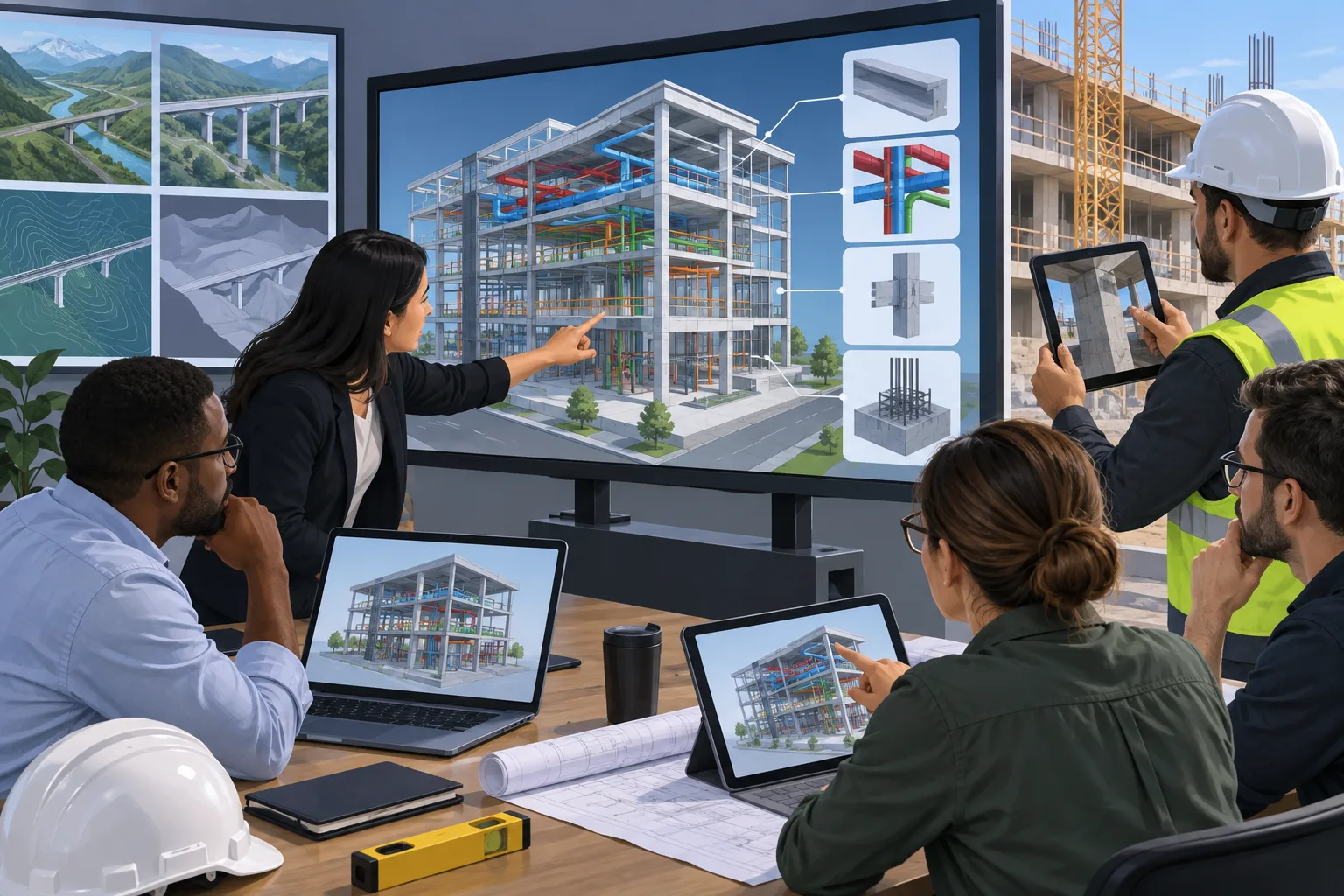
BIM-Coordinated Project
Observe BIM as coordinated information work: disciplines review geometry, properties, revisions, responsibilities, and interfaces together rather than treating the model as 3D geometry alone.
What 4D, 5D, 6D, and 7D usually mean
Industry commonly uses:
- 3D: geometric/model information;
- 4D: time or construction sequencing;
- 5D: quantities/cost;
- 6D / 7D: often sustainability, asset management, operations, or other lifecycle information.
The meanings of 6D and 7D vary among organizations and software ecosystems. Engineers should define the required information and purpose instead of assuming the label alone guarantees a standard data structure.
Common Data Environment and interoperability
A modern digital workflow needs controlled information exchange—not a folder full of unrelated files.
Important concepts include:
- a Common Data Environment (CDE) for managed information exchange;
- revision, status, approval, and suitability metadata;
- agreed naming and information requirements;
- open/interoperable formats where appropriate, including IFC-based exchange;
- coordination among civil, structural, architectural, MEP, geotechnical, surveying, and construction teams.
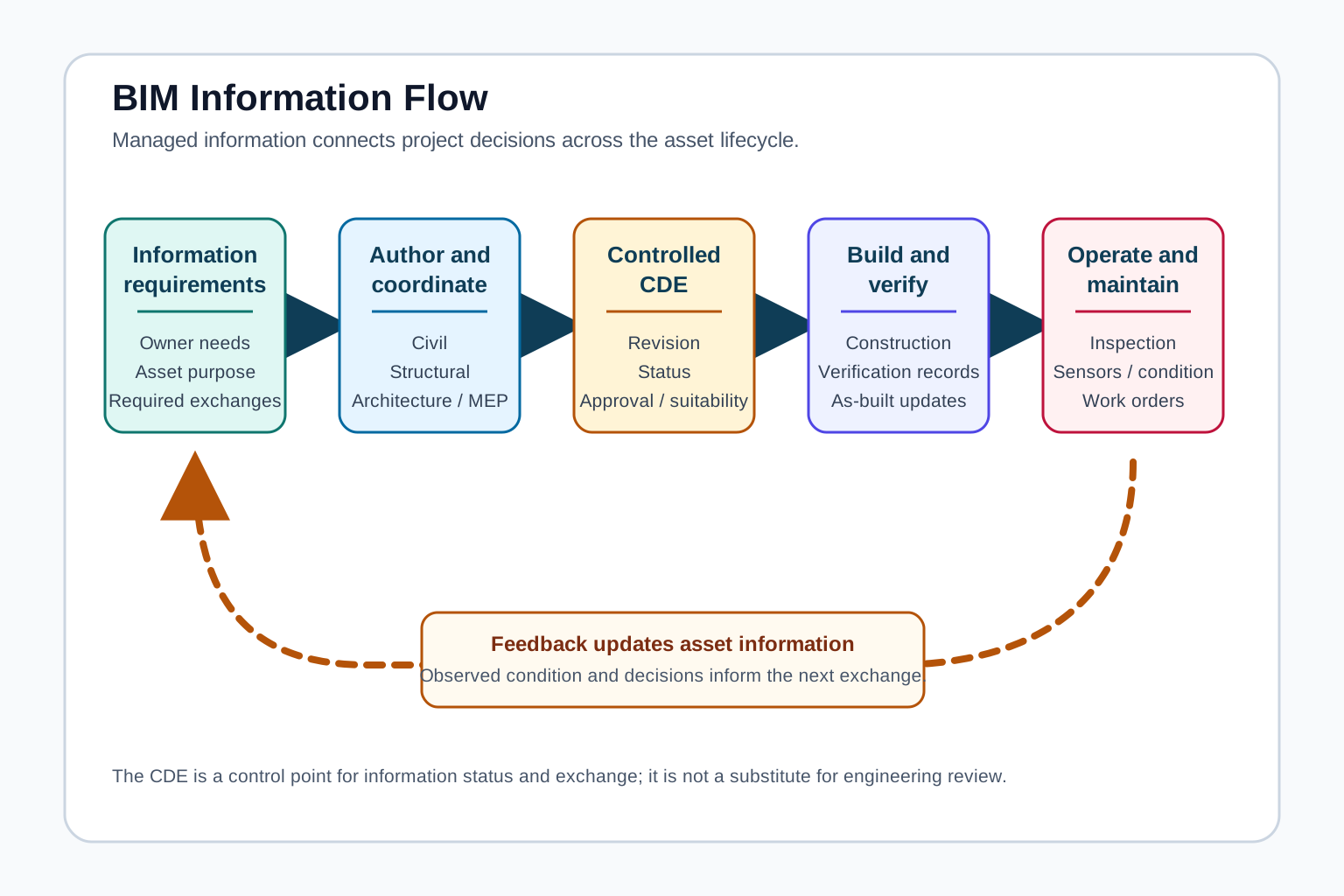
BIM Information Flow
Follow information from requirements through authoring, coordination, controlled exchange, construction verification, and operations; inspection findings and decisions feed updates back into the asset information.
Digital Twins and Asset Information
Digital Twin
A digital representation connected to information about a physical asset or system and used to support understanding, monitoring, simulation, or decision-making over time. The required level of live connectivity varies by use case, but a detailed BIM model alone should not automatically be called a digital twin.
From design model to operational decision support
A bridge digital-twin workflow might combine:
- geometry and inspection history;
- sensor or structural-health-monitoring data;
- traffic/environmental loading information;
- deterioration models;
- maintenance records;
- condition ratings;
- predicted intervention needs.
The value is not the visual model itself—it is the traceable relationship between asset data and engineering decisions.
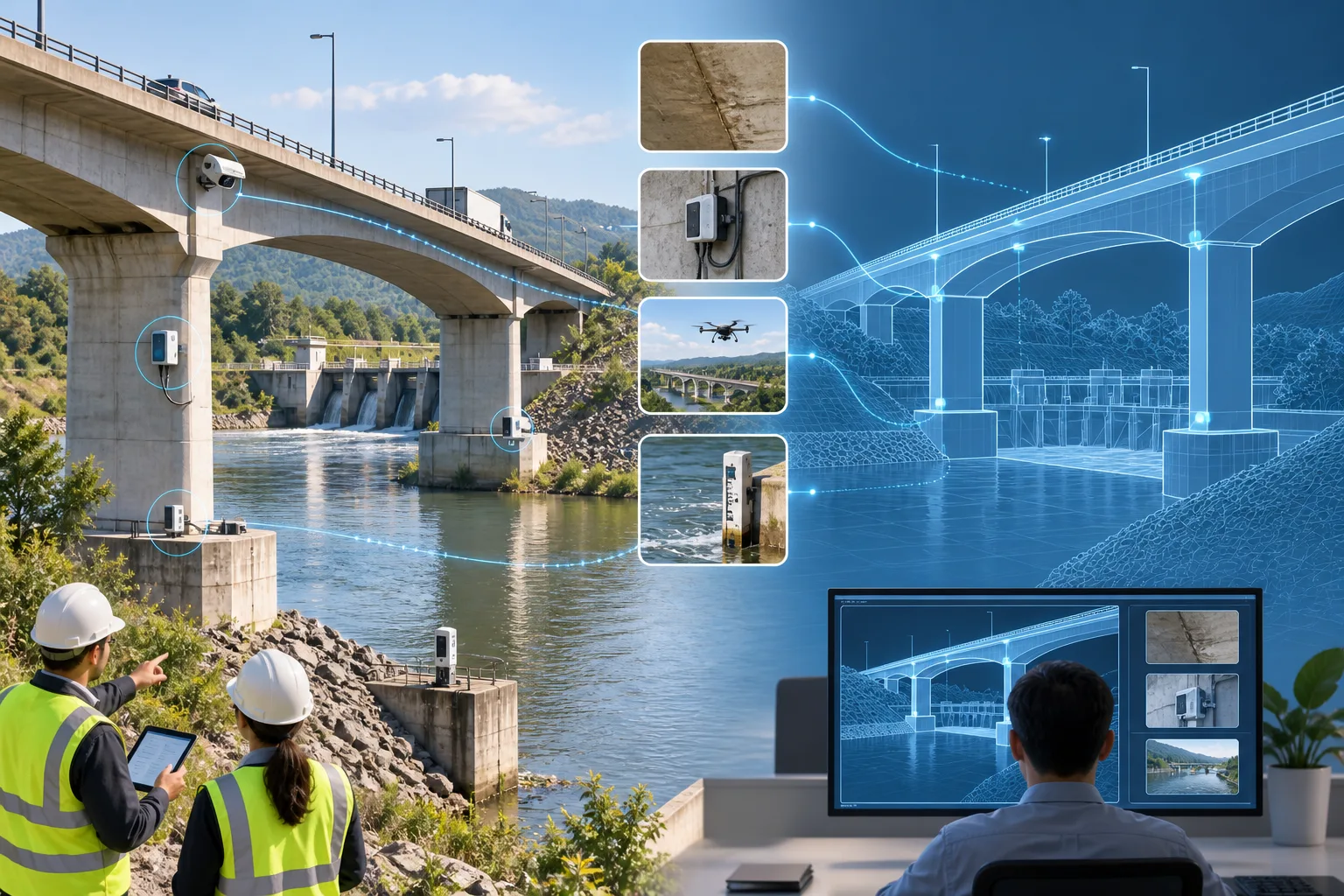
Digital Twin for Infrastructure
Connect the physical asset to inspection, sensor, deterioration, and maintenance information. The decision link—not the model's appearance alone—is what makes the representation useful.
Automation, AI, Drones, and Robotics
Where automation can help
- Drones / UAVs: imagery, progress documentation, mapping, stockpile measurement, and inspection of difficult locations subject to regulatory and accuracy requirements.
- Computer Vision: PPE/zone monitoring, progress recognition, crack or defect screening, and traffic observations.
- Machine Learning / Predictive Analytics: deterioration prediction, demand forecasting, risk classification, anomaly detection, and maintenance prioritization.
- Generative / Optimization Tools: exploration of alternatives within defined objectives and constraints.
- Document AI: search, classification, requirement extraction, summarization, and drafting support for large project document sets.
- Robotics and Automation: layout, scanning, repetitive fabrication, inspection, equipment guidance, and selected construction tasks.
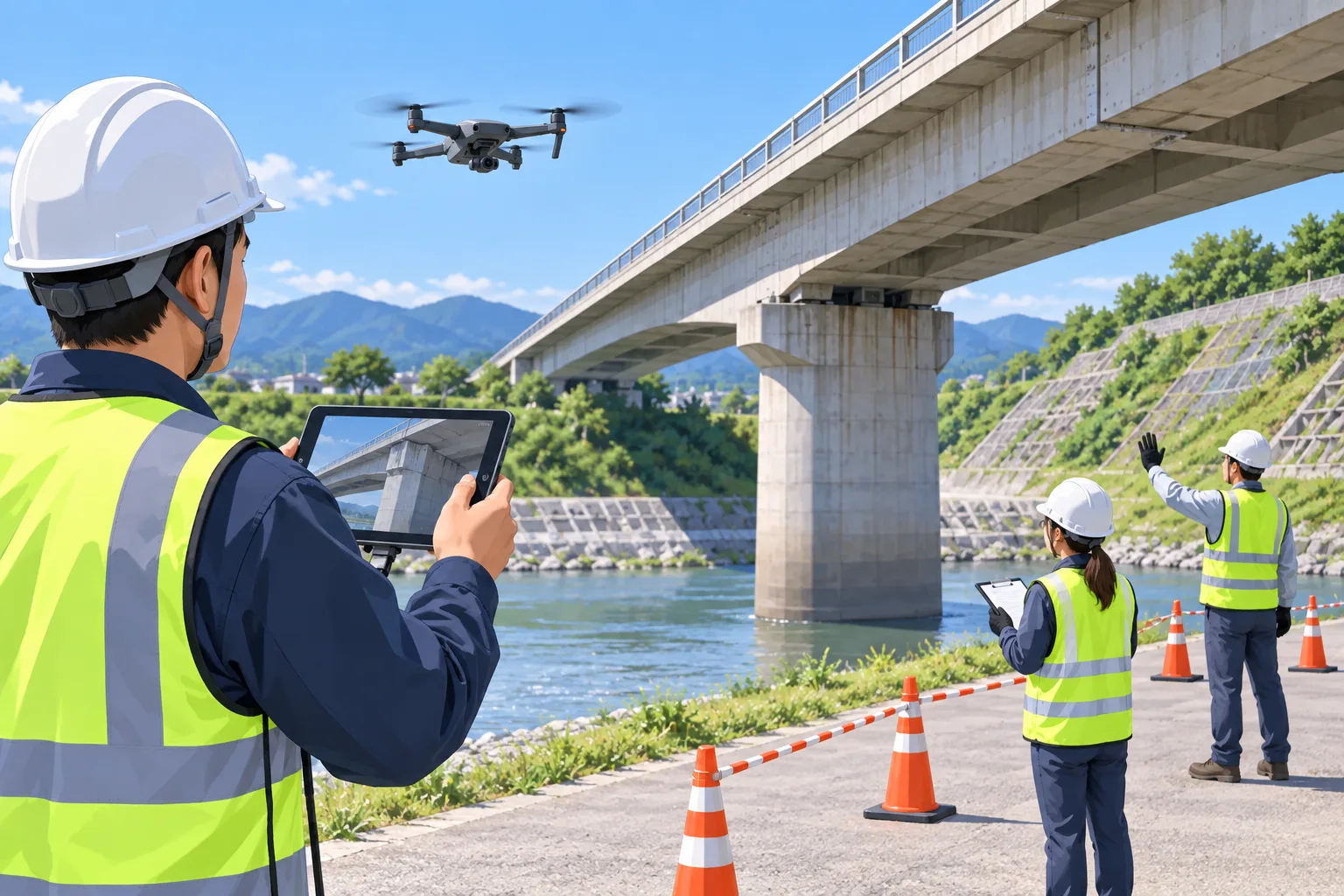
Drones and Remote Inspection
Remote imagery can expand access to difficult locations, but engineering use still depends on flight rules, image quality, location control, validation, and professional interpretation.
AI does not inherit professional responsibility
AI-generated calculations, reports, code references, quantities, drawings, schedules, and recommendations can be wrong while sounding convincing. Engineers must address:
- hallucinated facts or references;
- incorrect formulas or unit handling;
- hidden training-data limitations and bias;
- privacy and confidential project information;
- intellectual-property and licensing concerns;
- cybersecurity and data integrity;
- lack of traceability or reproducibility;
- automation bias and over-reliance;
- responsibility for checking and approving final work.
The professional remains responsible for verification and engineering judgment.
Smart Cities and Intelligent Infrastructure
A "smart" infrastructure system uses data and control to improve service, reliability, safety, efficiency, or maintenance. Sensors are useful only when they support a defined operational decision.
Examples of intelligent civil systems
- Structural health monitoring: accelerometers, strain, displacement, corrosion, or environmental sensors used to support inspection and assessment.
- Intelligent transportation systems (ITS): traffic detectors, adaptive signals, traveler information, transit priority, incident detection, and network management.
- Smart drainage and flood monitoring: rainfall, water-level, pump, gate, and forecast data supporting warning and operations.
- Smart water networks: pressure/flow monitoring, leak detection, metering, demand management, and asset prioritization.
- GIS-enabled asset management: location, condition, inspection, maintenance, and risk information linked to infrastructure inventories.
- Construction sensing: machine control, progress scanning, geofencing, equipment telematics, and environmental monitoring.
More sensors do not automatically mean better engineering
Every smart-infrastructure project needs decisions about sensor accuracy, calibration, sampling, communications, cybersecurity, power, maintenance, missing data, false alarms, data ownership, privacy, and what action should occur when a threshold is exceeded.
Modern Construction Methods
Modular and prefabricated construction
Off-site production can improve repetition, quality control, worker access, and schedule reliability, but benefits depend on early design coordination, transportation limits, lifting plans, tolerances, connections, logistics, supply-chain capacity, and project repetition.
Additive construction / 3D printing
Layered automated placement can produce selected concrete or mortar elements and complex geometries. It should not be simplified as a machine "printing a complete house" without other systems.
A finished building may still require:
- foundations;
- reinforcement or alternative structural provisions;
- floors and roofs;
- utilities and MEP systems;
- doors/windows and finishes;
- quality control and testing;
- code and permitting compliance.
Sustainable Materials and Durability
Embodied Carbon
Greenhouse-gas emissions associated with materials and construction across defined lifecycle stages, including extraction, manufacturing, transport, construction, maintenance/replacement where included, and end-of-life processes depending on the assessment boundary.
High-impact material strategies
Civil engineers increasingly evaluate:
- supplementary cementitious materials and reduced-clinker concrete systems;
- low-carbon cement and geopolymer-type binders where technically suitable;
- recycled aggregates and material reuse;
- high-durability concrete and corrosion-resistance strategies;
- ultra-high-performance concrete (UHPC) for selected high-value applications;
- fiber-reinforced concrete and FRP strengthening systems;
- recycled asphalt and optimized pavement materials;
- responsibly sourced timber / engineered timber where appropriate to the structural, fire, moisture, and regulatory context;
- design for repairability, disassembly, reuse, and longer service life.
Smart and functional materials
Research and specialized applications also include self-healing cementitious systems, shape-memory materials, conductive/sensing composites, advanced coatings, and other functional materials.
These technologies should be evaluated by evidence, field performance, constructability, cost, durability, availability, standardization, and lifecycle benefit rather than novelty alone.
Interactive Simulation
Use the embodied-carbon simulation as a comparative learning tool. A real lifecycle assessment requires clearly defined system boundaries, quantities, service life, maintenance assumptions, transport, data sources, and appropriate environmental product information.
Interactive learning lab · 3 experiences
Current Trends and Issues Learning Lab
Explore lifecycle carbon thinking, distinguish BIM from digital twins and smart infrastructure, and evaluate emerging technologies through capability, limitation, data, risk, and professional-responsibility lenses.
Infrastructure Lifecycle Carbon Explorer
Trace where environmental impacts can arise across an asset lifecycle instead of relying on a universal material factor or simplistic green/red score.
What to observe
A defensible lifecycle assessment depends on defined system boundaries, quantities, verified datasets, service life, maintenance assumptions, transport, energy, end-of-life scenarios, and the functional performance being compared.
Step 1 of 7
A1–A3: Product
Consider raw-material supply, transport to manufacturing, and manufacturing processes. Product-stage impacts depend on specific materials, plants, energy sources, recycled content, mix designs, and declared datasets.
Typical output: Product-stage inventory and verified environmental factors.
Educational boundary: The previous Orientation calculator used fixed generic carbon factors and arbitrary performance thresholds. This replacement intentionally teaches LCA method and uncertainty instead of presenting illustrative factors as project-specific truth.
Lifecycle Assessment and Whole-Life Performance
Life Cycle Assessment (LCA)
A structured method for evaluating environmental impacts associated with a product, process, or asset across defined lifecycle stages and boundaries.
Infrastructure lifecycle stages
A whole-life assessment can consider:
- raw-material extraction and processing;
- manufacturing;
- transportation;
- construction and installation;
- use and operation;
- inspection, maintenance, repair, and replacement;
- rehabilitation or adaptation;
- demolition/deconstruction;
- waste treatment, recycling, reuse, or disposal.
Embodied vs. operational vs. whole-life carbon
- Embodied carbon: emissions associated with materials and construction-related lifecycle stages within the defined boundary.
- Operational carbon: emissions associated with energy or operational use during the asset's service period where relevant.
- Whole-life carbon: a broader accounting that combines relevant embodied and operational lifecycle emissions.
For many infrastructure assets, durability and maintenance frequency can materially change lifecycle impact even when the initial material choice appears "green."
Climate Mitigation, Adaptation, and Resilience
Climate Mitigation
Actions that reduce greenhouse-gas emissions or increase removals, such as material efficiency, low-carbon energy, low-carbon transport, and reduced construction emissions.
Climate Adaptation
Adjustments that reduce harm or take advantage of changing climate conditions, such as increased drainage capacity, heat-resilient materials, flood protection, or revised design criteria.
Resilience
The ability of systems and communities to resist, absorb, adapt to, recover from, and improve after disruptive events while maintaining or restoring essential functions.
Resilience is not simply 'making everything stronger'
Examples include:
- redundant routes and utilities;
- safe-to-fail flood spaces and detention;
- emergency access and rapid repair strategies;
- replaceable structural components;
- monitoring and inspection plans;
- backup power and pumping;
- seismic isolation or damping for suitable applications;
- slope/drainage management;
- nature-based solutions and urban water retention.
Climate-Resilient Infrastructure
Read resilience as a system property: hazard-aware design is combined with protected functions, redundancy, monitoring, emergency access, and recovery planning.

Philippine Sustainability and Resilience Context
Why local context matters
Philippine infrastructure must account for:
- typhoons and extreme rainfall;
- earthquakes and active tectonics;
- landslides and steep terrain;
- riverine, urban, and coastal flooding;
- sea-level and coastal exposure;
- tropical heat, humidity, corrosion, and material weathering;
- dense urban growth and transport congestion;
- water, waste, and sanitation gaps;
- distributed island logistics and supply chains.
Green-building and sustainability frameworks
Relevant Philippine practice can involve the Philippine Green Building Code, BERDE, local ordinances, agency requirements, and project-specific sustainability criteria, alongside international frameworks such as LEED where selected by owners.
Rating systems are tools for organizing performance objectives; certification does not replace engineering analysis, code compliance, or lifecycle verification.
UN Sustainable Development Goals
The UN Sustainable Development Goals provide an international framework that helps connect infrastructure decisions with development outcomes; they do not replace engineering laws, codes, budgets, or local planning.
Direct CE connections
- SDG 6 — Clean Water and Sanitation: water supply, wastewater, drainage, and water-resource protection.
- SDG 9 — Industry, Innovation and Infrastructure: resilient and sustainable infrastructure and innovation.
- SDG 11 — Sustainable Cities and Communities: housing, mobility, disaster risk, planning, public space, and resilient urban services.
- SDG 13 — Climate Action: mitigation, adaptation, risk reduction, and climate-informed infrastructure planning.
Civil engineering decisions can also affect energy, health, inequality, responsible consumption, ecosystems, and economic development.
Globalization and ASEAN Practice
International collaboration changes the workflow
Global projects may require engineers to work across:
- different design codes and national annexes;
- FIDIC or other international contract frameworks;
- multinational review and approval systems;
- distributed digital teams and common data environments;
- different climate, materials, construction practices, and legal systems;
- language and cultural differences.
ASEAN Engineering Services MRA
The ASEAN Mutual Recognition Arrangement on Engineering Services provides a framework intended to facilitate professional mobility and cross-border services. Recognition does not mean unrestricted automatic practice: engineers remain subject to the domestic registration, collaboration, and practice requirements of the host ASEAN member state.
Common Misconceptions
Check the technology hype
- "BIM is just 3D CAD." False. BIM is fundamentally about managed information and collaboration across the asset lifecycle.
- "6D and 7D have one universal meaning." False. Industry usage varies; define the information requirement explicitly.
- "A BIM model is automatically a digital twin." False. A digital twin requires a meaningful relationship with the physical asset and decision process.
- "AI can approve engineering work if it is accurate most of the time." False. Professional responsibility, traceability, and verification remain necessary.
- "More sensors always make infrastructure smarter." False. Data must be reliable, maintained, secure, interpreted, and connected to actions.
- "A low-carbon material is automatically sustainable." False. Strength, durability, maintenance, transport, service life, constructability, and end-of-life also matter.
- "Resilience means making every component stronger." False. Redundancy, recovery, adaptability, safe failure, and operations are also important.
Apply It
Evaluate one 'future of CE' proposal
- Choose one technology: BIM, AI, sensors, drones, digital twins, modular construction, 3D printing, or a low-carbon material.
- Define the engineering problem it is supposed to solve.
- Identify the data or evidence required for it to work reliably.
- Identify one failure mode or limitation.
- Identify one verification step a professional engineer must perform.
- Identify one lifecycle or sustainability consequence.
- Explain whether the technology changes professional responsibility—or only changes the tools used to meet it.
Content currency
Technology terminology, software capabilities, standards, and regulatory frameworks evolve rapidly. This lesson was reviewed on 15 September 2026 with current ISO BIM information-management material and the ASEAN Engineering Services MRA framework in mind. Treat product-specific claims and emerging-technology performance as time-sensitive and verify them before professional use.
- BIM is a process for managed asset information, not merely intelligent 3D geometry.
- 4D/5D labels are common, while higher "dimension" labels vary; define requirements rather than relying on marketing terminology.
- Digital twins connect digital information with the physical asset and ongoing decisions; not every BIM model qualifies.
- AI, automation, drones, sensing, and robotics can improve productivity and insight but introduce verification, privacy, IP, cybersecurity, and accountability risks.
- Smart infrastructure is valuable when reliable data drives a defined operational or maintenance decision.
- LCA evaluates impacts across defined lifecycle stages, and whole-life performance can be more important than initial material impact alone.
- Climate mitigation, adaptation, and resilience are related but distinct engineering objectives.
- Philippine civil engineering must integrate sustainability with severe seismic, typhoon, rainfall, flood, slope, coastal, and tropical-exposure conditions.
- ASEAN and global frameworks facilitate collaboration but do not remove host-country professional requirements.
References
- ISO — ISO 19650-1:2018, Organization and digitization of information about buildings and civil engineering works, including BIM — Information management using BIM — Part 1: Concepts and principles
- United Nations — Sustainable Development Goals
- Department of Public Works and Highways — Philippine Green Building Code User Guide
- ASEAN — Mutual Recognition Arrangement on Engineering Services