Distinguish formal engineering terminology from Filipino translations, borrowed words, and construction-site vernacular.
Recognize common Filipino terms for structural members, materials, tools, earthworks, roads, drainage, surveying, safety, and construction activities.
Translate ordinary site instructions into technically precise engineering language without losing dimensions, locations, tolerances, or safety requirements.
Identify Filipino or site terms that are ambiguous and require clarification before work proceeds.
Communicate respectfully with workers, foremen, contractors, clients, and communities who use Filipino, English, or mixed Filipino-English terminology.
Preserve the controlling English/code/contract terminology when a Filipino equivalent is not exact or when the governing document uses a defined technical term.
Civil engineering practice in the Philippines is multilingual. Plans, specifications, codes, calculations, contracts, and formal reports are commonly written in English, while field coordination often uses Filipino, regional languages, Spanish-derived construction vocabulary, English loanwords, and code-switching. A competent engineer must understand this language environment without assuming that every site term has one exact technical equivalent.
This is a communication glossary, not a replacement for contract terminology
A Filipino or colloquial site term can help people understand one another, but the governing drawing, specification, code, approved method statement, and written instruction remain controlling. When a word is ambiguous, confirm the element, dimension, material, location, revision, and required action before work proceeds.
How Filipino technical vocabulary develops
Filipino engineering language naturally contains native terms, long-established Spanish borrowings, English technical terms, and locally adapted expressions. The Komisyon sa Wikang Filipino (KWF) recognizes borrowing as part of Filipino vocabulary and cautions against forcing respellings that become harder to read or less useful. For specialized engineering terms such as benchmark, shear, moment, slump, rebar, subgrade, RFI, BIM, or culvert, retaining the recognized technical term is often clearer than inventing a literal translation.
Interactive Filipino Site Communication Lab
Use the lab below to compare formal engineering English, Filipino explanations, and Philippine site vernacular, then practice clarifying an ambiguous instruction before anyone acts on it.
Interactive learning lab · 3 experiences
Filipino Civil Engineering Terms Learning Lab
Practice moving safely between formal engineering English, Filipino explanations, and Philippine site vernacular. The objective is clear technical communication—not replacing controlled drawings, specifications, measurements, or professional terminology with slang.
Filipino Site Vocabulary Explorer
Explore common words by construction context and see why a familiar site word can still require technical clarification.
What to observe
Many Philippine construction terms are borrowed, adapted, regional, trade-specific, or context-dependent. A useful engineer understands the site language while still converting it into an unambiguous technical requirement.
Structural members
haligi/poste · biga · slab/losa/sahig · pundasyon
On site, haligi or poste may refer to a vertical member, biga to a beam, and sahig or losa to a floor/slab. These words help communication but may not uniquely identify the designed element.
Confirm member mark or grid location
State dimensions and elevation
Use the approved drawing/detail reference
Do not assume poste always means one structural material or member type
Example: 'poste' could mean a reinforced-concrete column, steel post, fence post, utility pole, or another vertical member depending on context.
Three Language Levels You Will Hear
1. Formal engineering terminology
Used in calculations, drawings, specifications, contracts, permits, test reports, and professional correspondence.
Examples: reinforced-concrete column, 20 mm deformed bar, compacted subgrade, benchmark elevation, construction joint, allowable bearing pressure, Request for Information (RFI).
2. Filipino explanatory language
Used to explain technical ideas clearly to students, workers, clients, communities, or non-specialists.
Examples: haligi for a column-like vertical member, biga for a beam, pundasyon for foundation, paagusan for drainage, hukay for excavation, tambak for fill, and kapal for thickness.
3. Philippine site vernacular
Practical construction speech often mixes Filipino, English, Spanish-derived words, trade vocabulary, abbreviations, and regional usage.
Examples include poste, bakal, estribo, alambre, buhos, palitada, porma, level, hulog, asinta, hollow blocks, curing, backfill, and scaffold/andamyo.
Site vocabulary is useful, but meanings can vary by crew, trade, province, and company. Clarify before treating vernacular as a design instruction.
Bilingual Construction Briefing
Use Filipino or mixed-language explanation to build shared understanding, then confirm the controlling element, requirement, and action in precise technical terms.
Profession, People, and Project Roles
English / Formal Term
Filipino / Common Site Term
Usage Note
Civil engineer
inhinyerong sibil / civil engineer
“Civil engineer” remains common in professional use.
Engineer
inhinyero / engineer / engr.
“Engr.” is a written abbreviation, not a spoken technical definition.
Architect
arkitekto
Separate regulated profession; do not blur professional scopes.
Contractor
kontratista
Person or firm undertaking contracted construction work.
Owner / client
may-ari / kliyente
The legal client and property owner may be different entities.
Project manager
tagapamahala ng proyekto / project manager
Formal title depends on organization.
Site engineer
inhinyero sa site / site engineer
Common mixed-language usage.
Foreman
kapatas / foreman
Supervises a crew or trade activity.
Worker / laborer
manggagawa / trabahador / obrero
Prefer respectful, role-specific communication.
Carpenter
karpintero
Common construction trade term.
Mason
mason / kantero in some local usage
“Mason” is widely understood; local terms vary.
Welder
welder / manghihinang
“Hinang” refers to joining metals using a welding process; the exact process and procedure must still be specified where it matters.
Equipment operator
operator
Usually retained in English on site.
Survey crew
survey team / pangkat sa pagsukat
Do not confuse construction layout work with regulated geodetic-engineering responsibilities.
Inspector
inspektor
May represent owner, contractor, agency, consultant, or regulator; authority must be clear.
Safety officer
safety officer / opisyal sa kaligtasan
Use the formal designation required by applicable OSH rules.
Basic Dimensions and Geometry
Engineering Concept
Filipino / Common Term
Example
Length
haba
haba ng biga
Width
lapad
lapad ng footing
Height
taas
taas ng pader
Depth
lalim
lalim ng hukay
Thickness
kapal
kapal ng slab
Diameter
diyametro / diameter
diyametro ng tubo
Radius
radyus / radius
radius ng kurba
Area
lawak / area
lawak ng lote or slab area
Volume
bolyum / volume
bolyum ng kongkreto
Distance / spacing
agwat / pagitan / spacing
agwat ng bakal
Center-to-center
gitna-sa-gitna / c/c / o.c.
Keep the drawing notation when specified.
Horizontal
pahalang
pahalang na linya
Vertical
patayo
patayong haligi
Straight / aligned
tuwid / nakahanay / asintado
“Asintado” is site vernacular; verify what is being aligned.
Level
pantay / level
“Level” may mean elevation or horizontal condition; clarify context.
Plumb
tuwid na patayo / hulog
“Hulog” is common site language for checking verticality with a plumb line/bob.
Slope / grade
dalisdis / hilig / slope / grade
“Grade” has several technical meanings; preserve formal definition in documents.
Corner
sulok / kanto
“Kanto” is common conversational usage.
Edge
gilid
Identify the specific reference edge when dimensioning.
Structural Members and Building Parts
English / Formal Term
Filipino / Site Term
Engineering Note
Foundation
pundasyon
General system transferring structural actions to the ground.
Footing
footing / tuntungan in explanatory Filipino
Keep footing type explicit: isolated, strip, combined, mat, etc.
Column
haligi / poste
“Poste” can also mean post or utility pole; identify the structural element.
Beam
biga
Horizontal or inclined member primarily resisting bending/shear.
Girder
girder / pangunahing biga
Do not assume every large beam is formally classified as a girder.
Slab
slab / losa / sahig in context
“Sahig” means floor and may refer to finish, slab, or floor system; clarify.
Wall
dingding / pader
State whether structural, nonstructural, retaining, partition, masonry, etc.
Retaining wall
retaining wall / pader na panangga sa lupa
Formal term is safer on drawings and calculations.
Roof
bubong
Roof covering is not the same as the entire roof structural system.
Ceiling
kisame
Distinct from roof or floor slab above.
Stair
hagdan
Identify tread, riser, landing, flight, and structural system as needed.
Landing
landing / pahingahan ng hagdan
“Landing” is normally retained on plans.
Brace
brace / suhay
Temporary and permanent bracing must be distinguished.
Support
suporta / salalayan
Support condition in analysis must still be defined mechanically.
Joint / connection
dugtungan / koneksiyon
Structural joint behavior cannot be inferred from the ordinary word alone.
Expansion joint
expansion joint / puwang na galaw
Keep formal term because movement function is technically specific.
Construction joint
construction joint / dugtungan ng buhos
Not equivalent to an expansion joint.
Concrete, Reinforcement, and Formwork
Concrete and Reinforcement Site Terms
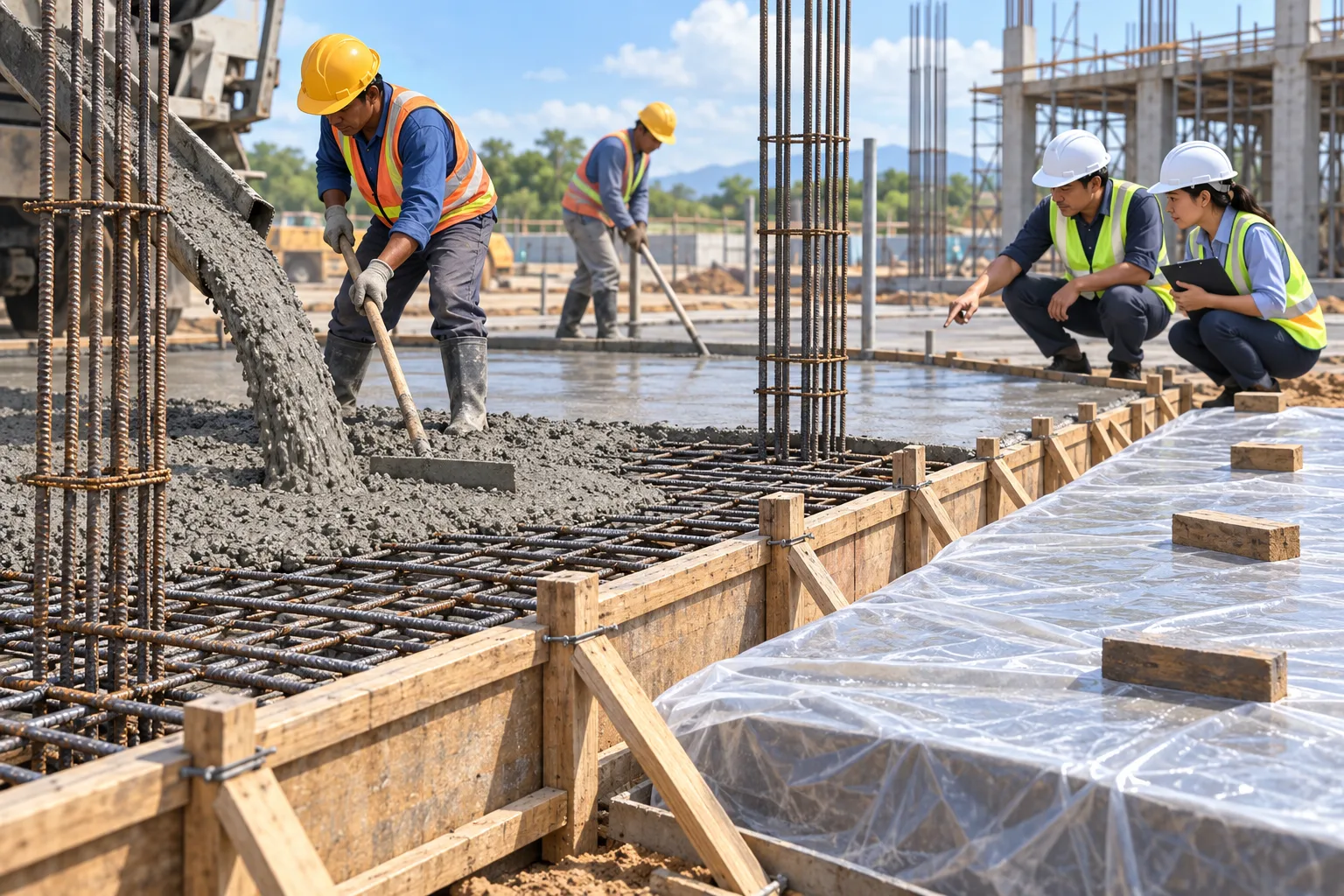
Distinguish concrete, cement, reinforcement, formwork, placement, consolidation, and curing instead of treating broad site words as interchangeable technical requirements.
English / Formal Term
Filipino / Site Term
Engineering Note
Concrete
kongkreto
Composite material; do not use “semento” as a synonym for concrete.
Cement
semento
Binder ingredient, not the complete concrete mixture.
Fine aggregate
pinong aggregate / buhangin
Project specification controls grading and quality.
Coarse aggregate
magaspang na aggregate / graba
“Graba” is common but aggregate requirements are more specific.
Water
tubig
Mixing water quality matters; not any available water is acceptable.
Concrete mix
halo / timpla ng kongkreto
Site “timpla” does not replace an approved mix design.
Concrete placement
pagbubuhos / buhos
“Buhos” may refer to the operation or a pour sequence.
Concrete pour
buhos
Define limits, sequence, joint location, and volume formally.
Consolidation / vibration
pag-vibrate / consolidation
Not merely “siksik”; avoid honeycombing without causing segregation.
Curing
curing / pag-aalaga ng kongkreto
“Diligan ang kongkreto” describes water curing only, not the whole concept of curing.
Slump
slump
Retain the technical test term.
Reinforcing bar
reinforcing bar / rebar / bakal
“Bakal” is broad; specify grade, diameter, type, and location.
Main bar
pangunahing bakal / main bar
Function and placement depend on member/design.
Stirrup
stirrup / estribo
Spanish-derived “estribo” is common on Philippine sites.
Tie
tie / estribo in column context
Distinguish column ties from beam stirrups where needed.
Tie wire
alambre / tie wire
Not a substitute for structural reinforcement.
Bar spacing
agwat ng bakal
State c/c spacing and drawing reference.
Lap splice
lap / sapaw ng bakal
Required splice length must come from design/code, not a verbal rule of thumb.
Development length
development length / haba ng pagkakakapit
Keep formal term for design calculations.
Hook / bend
kawit / liko / hook
Bar-bending detail governs dimensions and angle.
Cover
concrete cover / takip ng kongkreto
Do not confuse with finishing coat.
Formwork
porma / hulma / formwork
Temporary system must resist construction loads and maintain geometry.
Shoring
shoring / pansamantalang suporta
Distinguish from formwork sheathing and permanent supports.
Falsework
falsework / pansamantalang salalayan
Especially relevant to bridges and elevated concrete work.
Stripping / form removal
pagbabaklas ng porma
Removal timing depends on strength, member, and procedure—not a fixed folk rule.
Honeycomb
honeycomb / lungga-lungga in colloquial description
Use the formal defect term in inspection records.
Semento is not kongkreto
One of the most common language errors is saying “cement” when the material is actually concrete. Cement is one constituent of concrete. A formal instruction such as “increase cement” is materially different from “increase concrete quantity.”
Masonry, Carpentry, and Finishes
English / Formal Term
Filipino / Site Term
Engineering Note
Concrete hollow block
CHB / hollow block
Usually retained as CHB in Philippine documents.
Brick
ladrilyo / brick
Material and dimensions must be specified.
Mortar
mortar / argamasa in older usage
Do not confuse with concrete.
Plaster / render
palitada
Common term for cementitious wall finishing.
Screed
screed / palitada or leveling layer depending on crew
Clarify material, thickness, and function.
Tile
baldosa / tile
“Baldosa” is understood in some contexts; tile is more common professionally.
Timber / lumber
kahoy / tabla
“Tabla” commonly refers to boards, not every timber member.
Plywood
plywood / playwud in speech
Keep product grade/thickness formal.
Nail
pako
Specify size/type where relevant.
Screw
turnilyo
Spanish-derived and widely used.
Bolt
bolt / tornilyo in some speech
Do not let “turnilyo” blur bolt vs screw in structural work.
Nut
nut / tuwerka
Confirm hardware specification.
Washer
washer
Usually retained in English.
Paint
pintura
Coating system is more specific than ordinary paint terminology.
Putty
masilya / putty
Finishing material; not structural repair material unless specified product is approved.
Earthworks, Excavation, and Geotechnical Site Terms
Earthworks and Equipment Terms
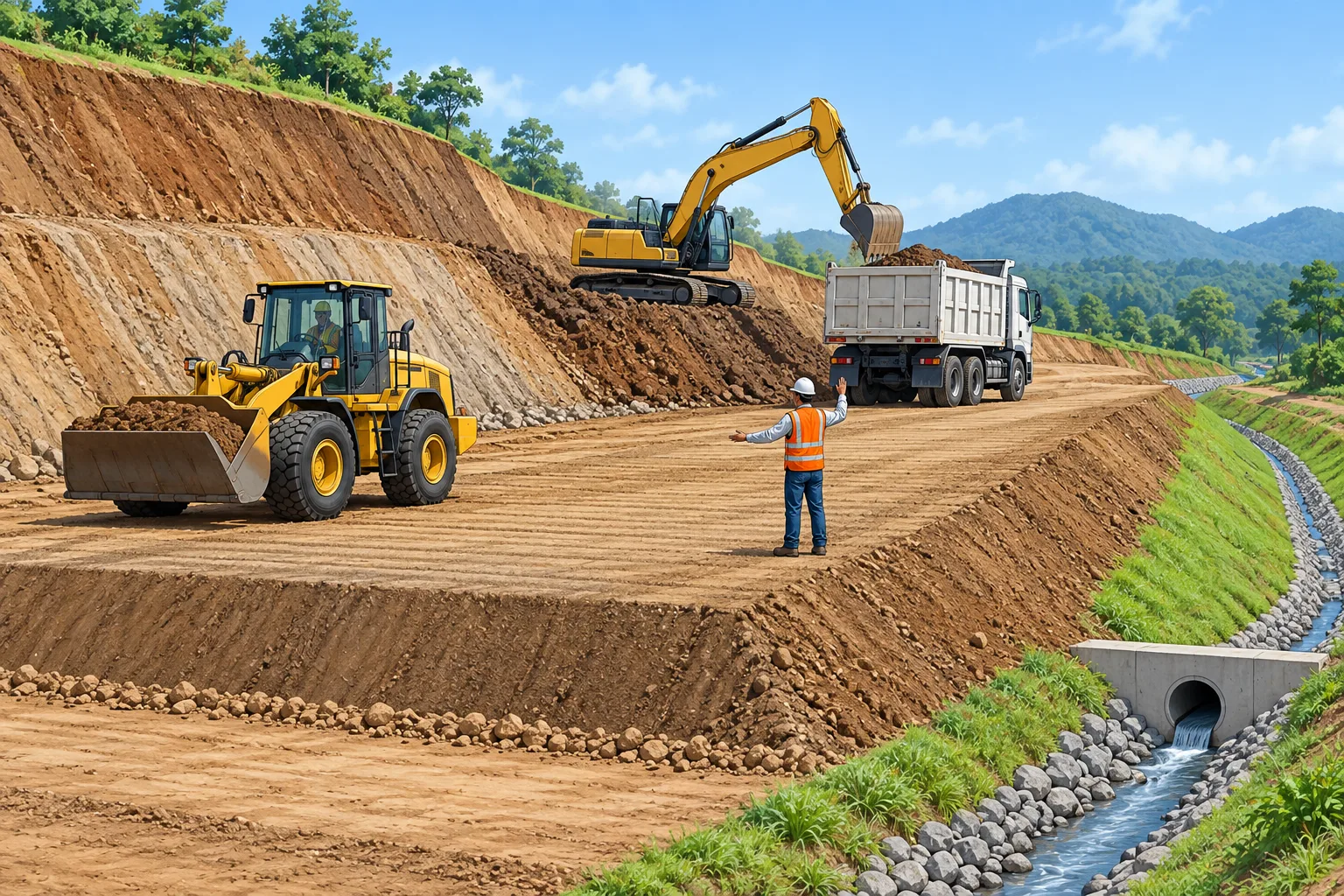
Connect everyday site words to the physical work: excavation, cut, fill, compaction, drainage, equipment movement, and the person coordinating the activity.
“Bato” is too broad for geotechnical classification.
Excavation
paghuhukay / hukay
State limits, depth, side support, utilities, and safety controls.
Cut
tabas / cut
Earthwork cut is not merely trimming.
Fill
tambak / fill
Material must meet specification.
Backfill
backfill / muling tambak
Define material, lift thickness, moisture, and compaction.
Embankment
embankment / pilapil / tambak na katawan
“Pilapil” has agricultural meanings; use formal term on infrastructure drawings.
Compaction
compaction / pagsisiksik or pagpapatibay in explanation
Formal density/moisture requirements control acceptance.
Subgrade
subgrade
Retain formal pavement/geotechnical term.
Base course
base course
Retain specification terminology.
Trench
trench / kanal na hukay
Distinguish an excavation trench from a drainage canal.
Slope
slope / dalisdis
Identify angle, ratio, grade, or design geometry explicitly.
Crest
tuktok ng dalisdis
Useful explanatory term.
Toe
paanan ng dalisdis
Common explanatory phrase.
Settlement
settlement / paglubog or pag-upo in colloquial speech
Formal geotechnical meaning must be preserved.
Bearing capacity
bearing capacity / kakayahang magdala ng lupa
Do not reduce to “matigas ang lupa.”
Groundwater
tubig-ilalim / groundwater
Water table/elevation should be measured and documented.
Surveying, Layout, and Positioning
Respect professional boundaries
Construction engineers frequently use survey information and perform construction layout, but cadastral, boundary, geodetic, and other regulated surveying activities may fall within the statutory practice of licensed geodetic engineers. Terminology does not change professional scope.
English / Formal Term
Filipino / Site Term
Engineering Note
Survey / measurement
pagsukat / survey
“Survey” covers many different technical activities.
Layout / setting out
pagmamarka / layout / setting out
Transfer design geometry using controlled references.
Stake
estaka / stake
Marker point; protect reference stakes from disturbance.
String line
pisi / nylon line / string line
Used for alignment or level references in simple work.
Plumb bob
hulog / plumb bob
Used to establish/check vertical reference.
Spirit level
level / nivel
“Nivel” is Spanish-derived and still heard on site.
Level instrument
level / automatic level / digital level
Do not confuse instrument with “level” as an elevation.
Benchmark
benchmark / BM
Stable reference elevation; usually keep the formal term.
Elevation
elevation / elebasyon / taas relative to datum
Formal elevation is referenced to a datum, not simply height.
Datum
datum
Keep formal surveying/geospatial term.
Alignment
alignment / hanay / asinta
“Asinta” or “asintado” can be colloquial; document coordinates/lines formally.
Centerline
centerline / gitnang linya
Often shown as CL or ℄ on drawings.
Station / chainage
station / chainage
Retain project notation to prevent location errors.
Coordinate
koordinado / coordinate
Use project coordinate system exactly.
As-built survey
as-built survey
Formal record of constructed geometry; do not replace with verbal measurements.
Roads, Transportation, and Site Development
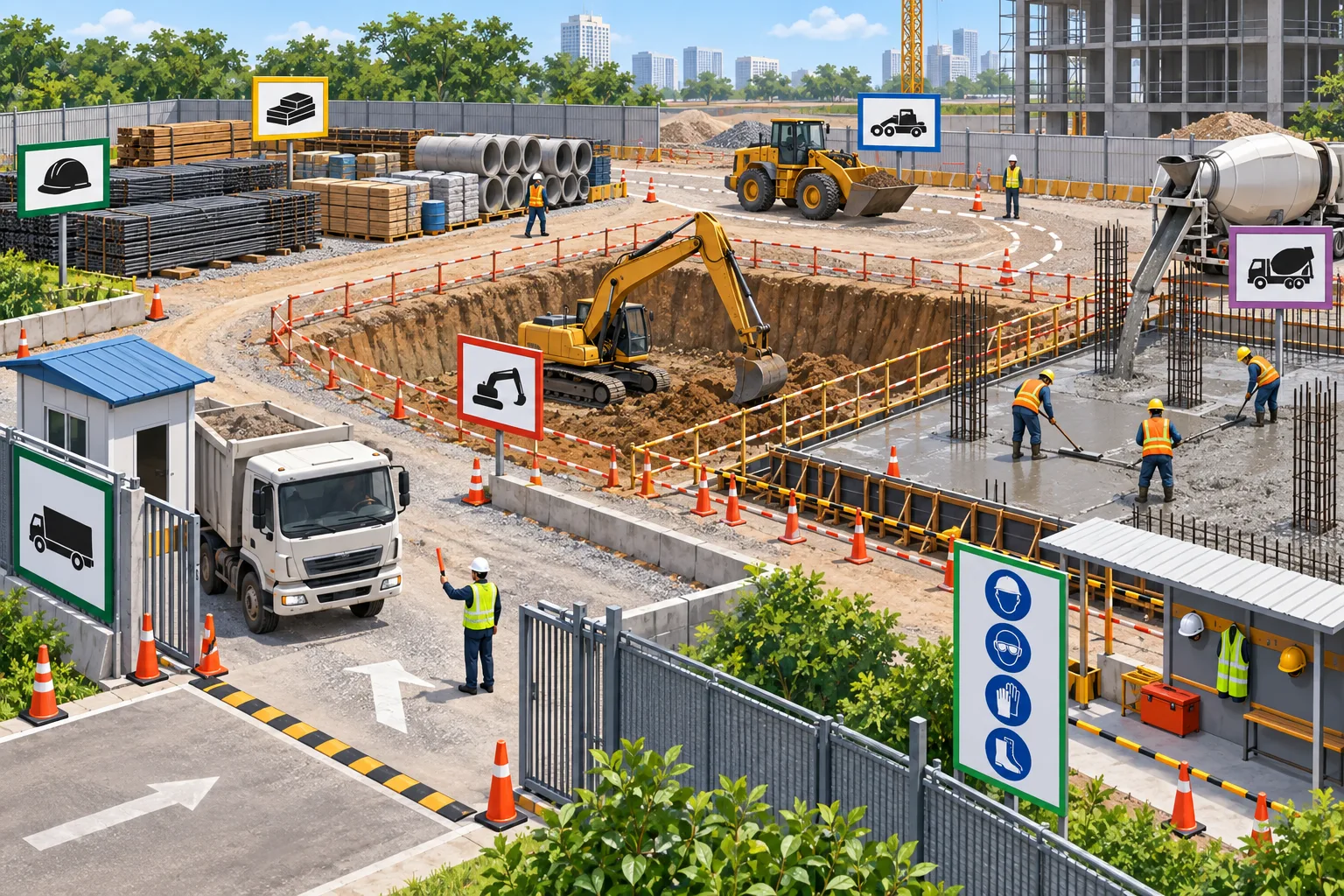
Construction Site Zones
Clarify site vocabulary by pointing to the actual work zone, access path, storage area, excavation, equipment route, and protected worker area.
English / Formal Term
Filipino / Common Term
Engineering Note
Road
kalsada / daan
“Daan” is broader; kalsada usually means constructed roadway.
Highway
lansangan / highway
“Highway” remains standard in technical documents.
Pavement
pavement / latag ng kalsada in explanation
Pavement is an engineered layered system, not only the visible surface.
Carriageway / traveled way
bahagi ng kalsadang dinaraanan
Use formal road-design terminology in drawings.
Lane
linya / lane
“Linya” may also mean pavement marking; clarify.
Shoulder
shoulder / balikat ng kalsada
“Balikat” is explanatory but formal term is safer.
Sidewalk
bangketa / sidewalk
Common Spanish-derived Filipino term.
Curb
curb / bordilyo
“Bordilyo” is common in Philippine construction.
Gutter
gutter / alulod in some contexts
“Alulod” may also mean roof gutter; identify roadway gutter explicitly.
Median
median / gitnang harang or island
Geometry/type varies.
Intersection
interseksiyon / sangandaan
“Sangandaan” is useful general Filipino; technical geometry remains formal.
Curve
kurba
State horizontal/vertical curve context.
Road grade
grade / ahon-baba / hilig
Formal percent grade controls design.
Road marking
marka sa kalsada
Follow applicable traffic-control standards.
Sign
karatula / traffic sign
“Karatula” is broad; regulatory sign class matters.
Bridge
tulay
One of the clearest direct Filipino equivalents.
Water, Drainage, and Sanitary Infrastructure
English / Formal Term
Filipino / Common Term
Engineering Note
Water
tubig
Basic term; technical quality/pressure/flow still require definitions.
Flow
daloy / agos
“Agos” often emphasizes moving water; formal flow has rate/direction.
Flood
baha
Flood depth, discharge, frequency, and extent should be quantified.
Drainage
paagusan / drainage
Includes system behavior, not only an open canal.
Canal / channel
kanal / daluyan
Distinguish irrigation, drainage, river-training, and other channels.
Drain
alulod / paagusan / drain depending on context
Identify roof, floor, roadway, or site drain.
Storm drain
storm drain / paagusan ng ulan
Keep system classification formal.
Sewer
alkantarilya / sewer
Distinguish sanitary sewer from storm drainage.
Manhole
manhole
Commonly retained in English; identify system.
Catch basin / inlet
catch basin / inlet / imburnal in common speech
Local use of “imburnal” varies; use plan terminology formally.
Culvert
culvert / pipe culvert / box culvert
Do not invent a literal translation where it reduces clarity.
Pipe
tubo
Specify material, diameter, class, slope, and service.
Water tank
tangke / imbakan ng tubig
Identify potable, fire, process, rainwater, etc.
Pump
bomba / pump
“Bomba” is common Spanish-derived usage; formal equipment data control.
Well
balon
Engineering wells require technical construction and water-quality controls.
Gutter / downspout
alulod / tubo pababa
Different from roadway drainage; state system.
Tools, Equipment, and Temporary Works
English / Formal Term
Filipino / Site Term
Note
Hammer
martilyo
Common hand tool.
Shovel
pala
Used for loose material handling; not a measurement tool.
Pickaxe
piko
Excavation/breaking tool.
Crowbar
bareta / crowbar
Site term varies.
Trowel
kutsara / trowel
Masonry/plastering tool; “kutsara” is colloquial trade usage.
Tape measure
metro / medida / tape
“Metro” may mean the measuring tape itself or a metre; clarify.
Level
nivel / level
Tool and geometric condition share the same site word.
Plumb bob
hulog
Vertical-reference tool.
Saw
lagari
Hand/power saw type should be specified.
Grinder
grinder
Usually retained in English.
Drill
barena / drill
“Barena” is common for boring/drilling tool.
Welding machine
welding machine
Equipment rating/process must be specified.
Concrete mixer
mixer
Usually retained in English.
Concrete vibrator
vibrator
Used for consolidation, not as a cure for poor mix design.
Scaffolding
andamyo / scaffold
Must be designed/erected/inspected as required; ordinary term does not imply safety.
Ladder
hagdan / ladder
Portable ladder is distinct from permanent building stair.
Crane
crane / kreyn
Lifting plan and capacity govern operations.
Backhoe / excavator
backhoe / excavator
Distinct machines; site speech sometimes blurs them.
Dump truck
dump truck
Retained in English.
Roller / compactor
roller / compactor
Identify equipment appropriate to material and lift.
Common Construction Actions and Instructions
English Action
Filipino / Site Expression
What a Precise Instruction Should Add
Measure
sukatin
reference points, unit, tolerance
Mark
markahan / lagyan ng marka
drawing/grid/coordinate reference
Align
ihanay / iasinta / ituwid
axis/edge/centerline and tolerance
Level
ipantay / i-level
target elevation or allowable deviation
Plumb
ituwid nang patayo / ihulog
vertical reference and tolerance
Cut
putulin / tabasin
material, location, dimension, method
Bend
baluktutin / iliko
radius/angle/bar-bending detail
Tie
itali
material, connection point, required fastening
Tighten
higpitan
torque or procedure if technically required
Loosen
luwagan
component and safe condition
Install
ikabit / ilagay
exact component, orientation, drawing reference
Remove
alisin / baklasin
sequence, temporary support, authorization
Excavate
hukayin
limits, depth, slope/shoring, utilities
Backfill
tambakan / mag-backfill
approved material, lift thickness, moisture, density
approved repair procedure/material—not an improvised patch
Translate the requirement, not just the words
“Pantayin mo iyan” may sound clear, but an engineer should ask: Pantay relative to what? What elevation? Which datum? What tolerance? The goal is not to replace Filipino with English; it is to preserve the engineering requirement while communicating in the language people understand.
Site Quantity and Measurement Language
Common quantity words
piraso / pcs — pieces;
sako / bag — commonly used for bagged cement, but bag mass/product must be confirmed;
metro — metre, or colloquially the tape measure itself;
metro kuwadrado / m² — square metre;
metro kubiko / m³ — cubic metre;
kilo / kg — kilogram in ordinary speech;
tonelada / t — tonne;
litro / L — litre;
kada — per/every, as in “kada 200 mm,” but drawings should state spacing formally;
kalahati — half;
isang-kapat — one quarter.
Legacy inch and lumber expressions
Philippine sites may still use expressions such as dos por dos, dos por tres, dos por kuwatro, kalahating pulgada, tres-kuwatro, or nominal inch-based material sizes. These are useful to recognize, but the engineer must verify the actual specified dimension, product standard, and unit system. A colloquial nominal size is not automatically the measured finished size.
Safety Language You Must Understand Immediately
Clarify Safety Communication
When a safety instruction is unclear, pause, ask, demonstrate, confirm shared understanding, and document the requirement before proceeding.
English / Safety Term
Filipino / Site Expression
Meaning in Practice
Danger
panganib / delikado
Requires immediate attention to the actual hazard.
Warning
babala
Communicate hazard and required action clearly.
Stop work
itigil ang trabaho / stop work
Use when work must cease under applicable procedure/authority.
Keep out
bawal pumasok / huwag pumasok
Access-control instruction.
Barricade
harang / barikada
Physical/access control, not merely a verbal warning.
Fall hazard
panganib ng pagkahulog
Identify edge/opening/work-at-height condition.
Falling objects
nahuhulog na bagay / bagsak na materyal
Requires exclusion/control, not just a hard hat.
Excavation hazard
panganib sa hukay
Includes collapse, access, water, utilities, atmosphere, equipment.
Electrical hazard
panganib sa kuryente
Isolation and competent controls may be required.
PPE
PPE / kagamitang pansariling proteksiyon
Keep formal PPE requirements and specific equipment clear.
Hard hat
hard hat / helmet
“Helmet” alone should not obscure required rating/type.
Safety shoes
safety shoes / bota pangkaligtasan
Foot protection must match hazards.
Gloves
guwantes
Correct glove type depends on task/hazard.
Safety glasses
salaming pangkaligtasan
Eye protection.
Harness
harness / full-body harness
Must be part of a complete fall-protection system.
Lifeline
lifeline
Formal fall-protection terminology should be retained.
State alarm, contact, route, assembly point, and response procedure.
Words That Are Common but Technically Ambiguous
Never act on these without context
poste — column, post, pole, or temporary support?
bakal — reinforcing bar, structural steel, wire, plate, or another metal item?
sahig — structural slab, floor system, screed, or floor finish?
level — instrument, target elevation, or horizontal condition?
hulog — plumb/vertical check, drop, or downward direction?
porma — concrete formwork, shape, or layout?
timpla — approved concrete mix design, mortar proportion, paint mixture, or an informal field mix?
kanal — drainage channel, trench, gutter, or utility excavation?
tubo — water, sewer, drainage, conduit, casing, or structural tube?
buhos — concrete placement operation, pour section, scheduled pour, or volume?
tambak — engineered fill, stockpile, backfill, or waste pile?
ayos — repair, alignment, finishing, cleaning, or acceptance correction?
Clarify an ambiguous site instruction
STEP-BY-STEP
Identify the object. What exact member, material, equipment, or area is being discussed?
Locate it. Drawing number, grid, station, coordinate, floor, chainage, or physical reference.
Define the action. Install, remove, align, repair, pour, cut, compact, inspect, etc.
State the measurable requirement. Dimension, elevation, grade, spacing, strength, density, tolerance, or quantity.
Check authority and revision. Is the instruction consistent with the current approved drawing/specification/method?
Confirm safety controls. Does the action alter excavation stability, temporary works, lifting, electrical isolation, work at height, or other hazards?
Document material decisions. Translate the discussion into the appropriate written record when it changes or clarifies controlled work.
Formal Translation Examples
From site speech to engineering instruction
Site speech: “Boss, ipantay natin iyong poste sa kabila.”
Engineering clarification: “Align Column C3 on Grid B-4 with the approved grid centerline and verify plumbness within the project tolerance before concrete placement.”
The second statement preserves the understandable idea—ipantay/ihanay—while adding the exact member, reference, verification, and timing.
Concrete example
Site speech: “Dagdagan ng tubig para lumambot ang timpla.”
Engineering response: Do not authorize uncontrolled water addition. Verify the approved concrete mix, delivery ticket, elapsed time, measured slump, project specification, and permitted adjustment procedure.
Knowing the Filipino phrase is useful precisely because the engineer must recognize when a casual instruction can change material performance.
Earthwork example
Site speech: “Tambakan na lang natin hanggang pantay.”
Engineering clarification: Confirm the approved fill material, formation elevation, lift thickness, moisture conditioning, compaction equipment, target density, and field-testing requirement. “Pantay” alone is not an acceptance criterion.
Communication with Communities and Non-Engineers
Use plain Filipino without losing technical truth
Civil engineers often explain projects to residents, property owners, workers, public officials, and affected communities. Good communication means translating meaning, not hiding uncertainty behind jargon.
Examples:
stormwater detention → pansamantalang pag-iimbak ng tubig-ulan upang hindi sabay-sabay ang pag-agos pababa;
retaining wall → istrukturang panangga sa lupa upang makontrol ang pagguho o paggalaw nito;
settlement → pagbaba o paglubog ng pundasyon/lupa, with the amount and cause explained;
road grade → sukat ng ahon o baba ng kalsada, normally expressed as a percentage;
load path → paraan kung paano dumadaan ang puwersa mula sa slab/biga/haligi patungo sa pundasyon at lupa.
Do not oversimplify risk
Plain language should make engineering more understandable, not falsely certain. Instead of saying “ligtas iyan” without qualification, explain what was checked, what conditions the conclusion assumes, and what limitations or maintenance requirements remain.
Regional and Trade Variation
There is no single nationwide construction-site dialect. A term common in Metro Manila may be uncommon in the Cordilleras, Visayas, or Mindanao; a carpenter may use a word differently from a steel fixer or heavy-equipment operator. Filipino itself also incorporates vocabulary from many Philippine languages and from Spanish and English.
Professional rule for regional terms
If you hear a term you do not know:
do not pretend to understand it;
ask the speaker to point to the object or demonstrate the intended action;
repeat the meaning back in measurable terms;
connect it to the drawing/specification terminology;
document any instruction affecting controlled work.
Common Misconceptions
Check your assumptions
“Every English engineering word should have a Filipino translation.” False. Keeping an established technical term is often clearer and safer.
“Site slang is incorrect and should never be used.” False. It is valuable for communication, but it must not replace precise controlled terminology.
“Poste always means column.” False. It can mean several types of vertical members or poles.
“Semento and kongkreto are the same material.” False. Cement is an ingredient of concrete.
“Pantay means the work satisfies tolerance.” False. A measurable datum/elevation/alignment and tolerance are still required.
“Diligan ang kongkreto fully defines curing.” False. Water curing is one method; curing is the broader moisture/temperature protection process required by the specification.
“If workers understand the instruction, documentation is unnecessary.” False. Material decisions and changes to controlled work still require appropriate written records.
Apply It
Build a bilingual site instruction
STEP-BY-STEP
Select one activity: setting a column, placing concrete, trench excavation, road subgrade compaction, drainage-pipe installation, or scaffolding.
Write the instruction first in ordinary Filipino or mixed Filipino-English as it might be spoken on site.
Identify every ambiguous word in the instruction.
Rewrite it using the exact element/location, drawing reference, material, dimension, tolerance, acceptance criterion, and safety control.
Explain the final instruction in plain Filipino to a non-engineer without changing the technical requirement.
Ask a classmate to interpret it independently. Revise any phrase that can reasonably produce two different actions.
Key Takeaways
Philippine civil-engineering practice is multilingual; engineers must be comfortable with formal English terminology, Filipino explanations, and common site vernacular.
Formal drawings, specifications, codes, contracts, and approved instructions control the work. A colloquial term does not override them.
Useful Filipino terms include haligi, biga, pundasyon, dingding, bubong, hagdan, hukay, tambak, paagusan, kalsada, tulay, haba, lapad, taas, lalim, kapal, agwat, and many others.
Common site terms such as poste, bakal, estribo, alambre, buhos, timpla, porma, palitada, nivel, hulog, asinta, backfill, curing, and scaffold must be understood in context.
Some words are dangerously broad: bakal, poste, sahig, level, kanal, tubo, timpla, buhos, tambak, and ayos should trigger clarification.
Cement is not concrete; a floor is not automatically a slab; water curing is not the complete definition of curing; and “level” or “pantay” is not a measurable acceptance criterion by itself.
Good bilingual communication preserves location, dimensions, units, material requirements, tolerances, safety controls, approval status, and documentation.
When there is no exact Filipino equivalent, retaining the recognized engineering term is better than inventing a misleading translation.
Respect regional and trade vocabulary, but verify unfamiliar terms instead of guessing.
The engineer's goal is not to sound more English or more Filipino; it is to make the engineering requirement understood correctly and executed safely.