ARCHE 2: Strength of Materials
Learning Objectives
- Relate external loads and support reactions to internal force, stress, strain, and deformation.
- Distinguish strength, stiffness, serviceability, and stability questions.
- Apply core mechanics models for axial loading, pressure vessels, torsion, beams, columns, and combined stress.
- Interpret stress transformation, Mohr's Circle, and strain-energy methods as extensions of the same equilibrium-compatibility-material framework.
- Recognize the assumptions and applicability limits of each analytical model instead of treating simplified equations as universal design rules.
Course Purpose
Strength of Materials extends statics by allowing structural members to deform. The course connects external actions to internal stress, strain, deformation, stiffness, stability, and energy so architectural students can understand how structural members respond before progressing to material-specific design courses.
The Member System Behind the Mechanics
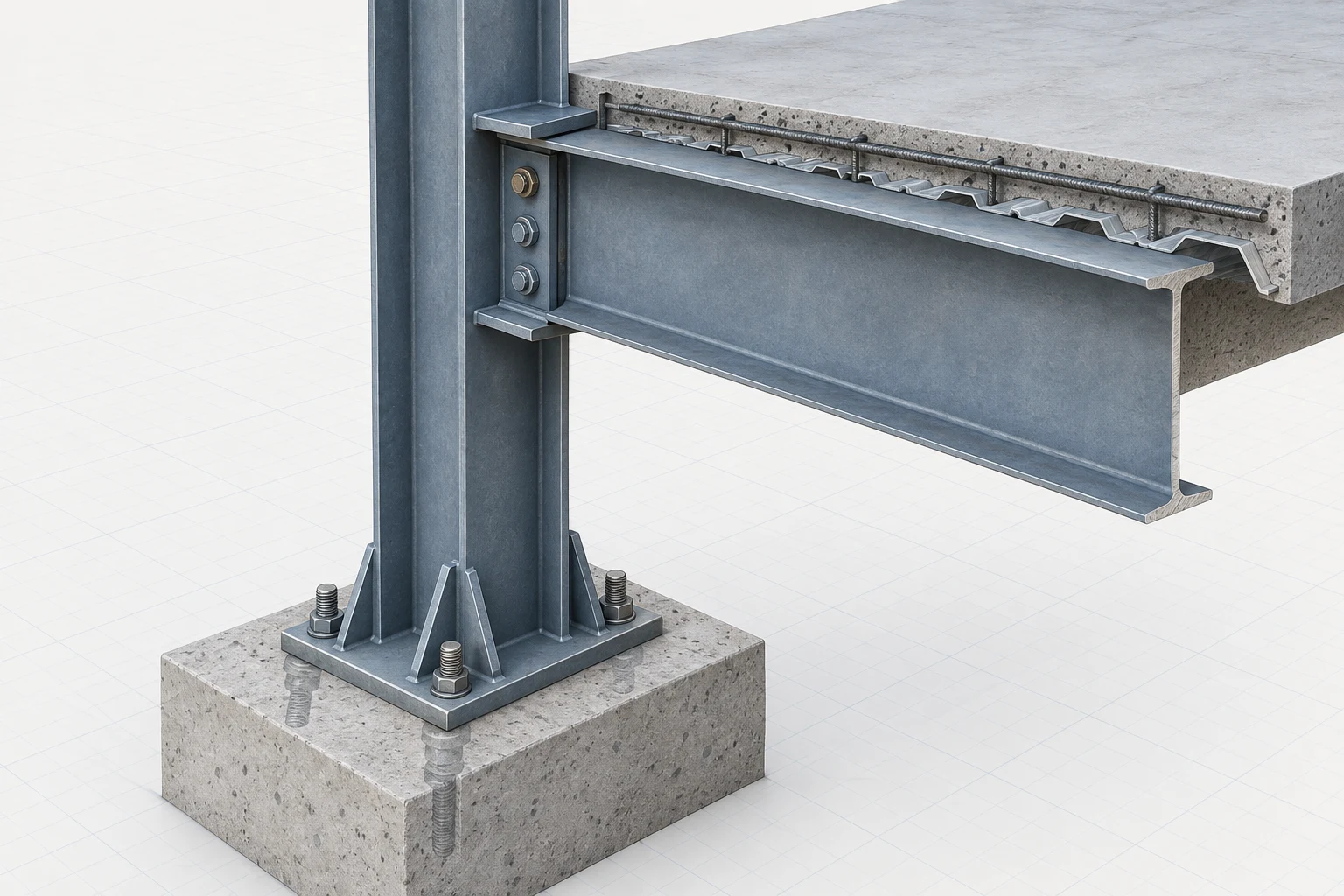
This connected beam-column assembly provides a physical anchor for the member, section, material, and support interfaces that later ARCHE 2 models idealize. It is qualitative context, not a load-path diagram or a design detail.
Read the Member Context
Notice the connected beam, column, slab edge, base plate, and concrete support as one structural assembly. The later lessons isolate portions of this system to study stress, strain, deformation, stability, and energy; exact forces, dimensions, and design checks remain in the deterministic lesson visuals and formulas.
Prerequisite
ARCHE 1 (Mechanics) or equivalent statics preparation is essential. You should be comfortable with free-body diagrams, equilibrium equations, support reactions, resultants, centroids, and second moments of area before beginning ARCHE 2.
Course Progression
The subject is organized from direct one-dimensional response toward multi-action and stability problems. Early modules establish stress, strain, deformation, and constitutive behavior. Middle modules apply those ideas to pressure vessels, torsion, beam internal forces, beam stresses, and deflection. Later modules extend the framework to stress transformation, eccentric and combined loading, column stability, and energy methods.
Course Modules
- Module 1 — Simple Stresses: normal, shear, bearing, thermal, net-section, and allowable stress.
- Module 2 — Simple Strain and Deformation: axial strain and deformation, Hooke's law, stress-strain behavior, Poisson effects, and elastic constants.
- Module 3 — Thin-Walled Pressure Vessels: cylindrical and spherical membrane stresses with explicit thin-wall applicability checks.
- Module 4 — Torsion: circular-shaft shear stress, polar moment, angle of twist, power transmission, and compatibility.
- Module 5 — Shear and Moment in Beams: support reactions, shear-force diagrams, bending-moment diagrams, differential relations, and singularity functions.
- Module 6 — Stresses in Beams: flexural stress, section modulus, transverse shear stress, and beam-theory assumptions.
- Module 7 — Deflection of Beams: elastic curves, double integration, moment-area, conjugate-beam concepts, and superposition.
- Module 8 — Principal Stresses and Mohr's Circle: plane-stress transformation, principal stresses, maximum shear stress, and orientation.
- Module 9 — Combined Stresses: superposition, eccentric loading, kern and middle-third behavior, and local combined stress states.
- Module 10 — Columns: radius of gyration, effective length, slenderness, Euler buckling, imperfections, and local-versus-global stability.
- Module 11 — Strain Energy: elastic energy, resilience, impact idealizations, Castigliano's theorem, and reciprocity.
A Consistent Mechanics Framework
Most ARCHE 2 problems can be organized around four ideas:
- Equilibrium determines reactions and internal actions.
- Geometry supplies area, centroid, moment of inertia, polar moment, and section dimensions.
- Material behavior relates stress to strain or force to deformation within a stated constitutive model.
- Compatibility enforces displacement or rotation constraints whenever equilibrium alone is insufficient.
The exact equations change by topic, but this framework remains consistent across axial, torsional, flexural, stability, and energy problems.
Model Assumptions Are Topic-Specific
Strength of Materials does not assume that every real material is homogeneous, isotropic, and perfectly linear elastic in every situation. Those are common idealizations used by selected introductory equations. Each lesson states the assumptions relevant to its model—for example, thin-wall membrane behavior, circular-shaft Saint-Venant torsion, Euler-Bernoulli beam theory, plane stress, ideal Euler buckling, or linear-elastic energy methods.
When a material or structural system violates those assumptions, use a model and governing design standard appropriate to the actual behavior.
Mechanics Equations Are Not Complete Building Design Procedures
ARCHE 2 develops mechanics fundamentals. Equations such as , , , , and Euler's explain structural response under stated assumptions; they do not replace material-specific resistance factors, load combinations, detailing provisions, serviceability limits, connection requirements, or other provisions of the governing structural code.
How to Use the Lessons
Read each theory page first, interact with its diagrams or simulations where provided, then work through the corresponding examples. For multi-step analysis topics, follow the lesson workflow diagrams and use the examples to check equilibrium, signs, units, boundary conditions, and model applicability.
- ARCHE 2 links statics to deformation, stress, stiffness, stability, and energy.
- The course progresses from direct stress and strain to beams, transformed/combined stress, column stability, and energy methods.
- Equilibrium, geometry, material behavior, and compatibility provide a recurring problem-solving framework.
- Simplified mechanics equations are valid only within their stated assumptions.
- Module 11 strain energy completes the ARCHE 2 sequence and supports later structural-analysis methods.