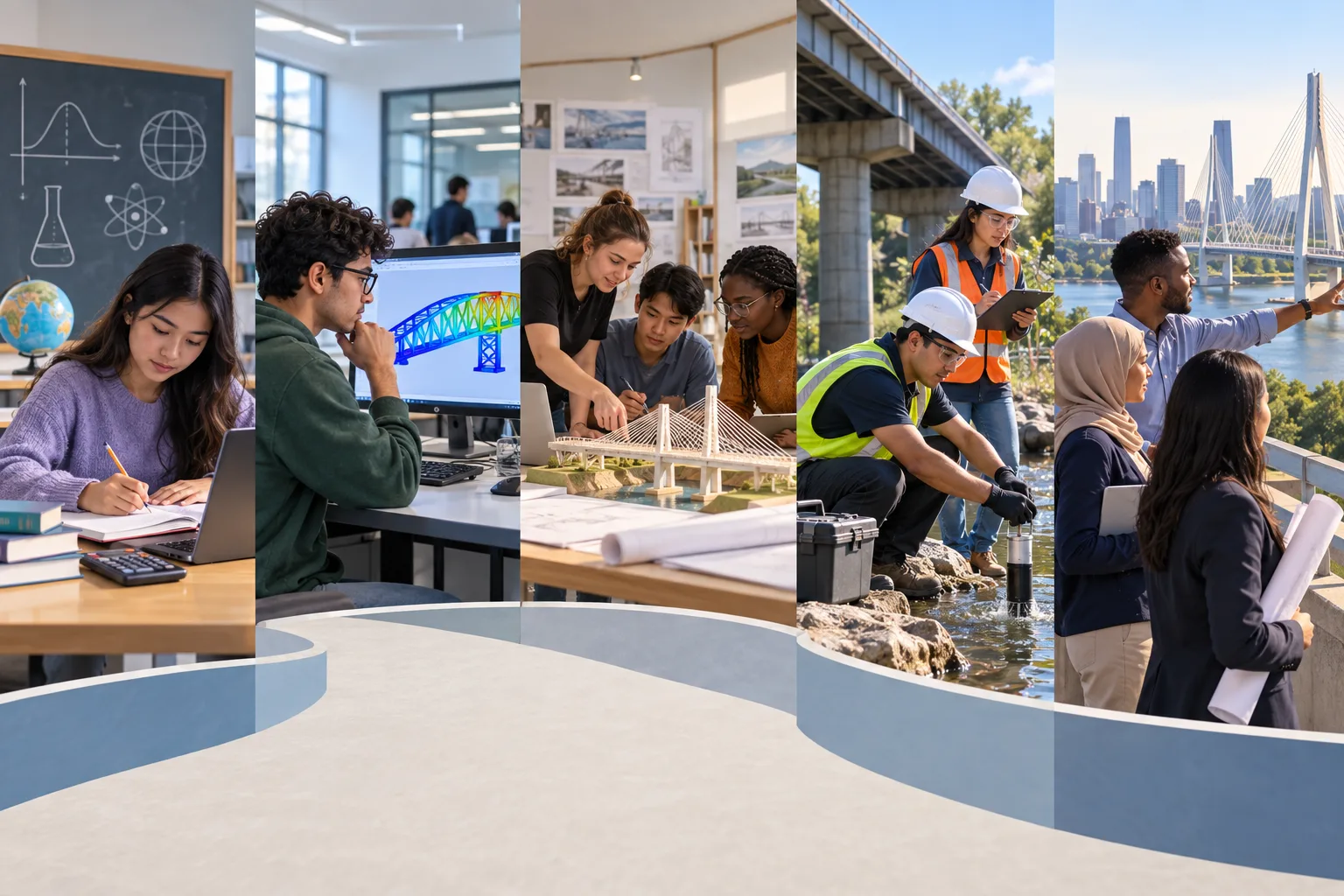
Explain how mathematics, science, engineering sciences, professional courses, laboratories, design work, and general education connect in a BSCE program.
Recognize prerequisite relationships among major civil engineering subjects instead of treating courses as isolated requirements.
Explain the purpose of laboratory testing, uncertainty, verification, and engineering documentation.
Describe Outcomes-Based Education (OBE) accurately, including the roles of Program Educational Objectives and Student Outcomes.
Distinguish fundamental engineering capabilities from software-specific skills.
Apply academic-integrity principles to calculations, laboratory data, technical writing, research, collaboration, and AI-assisted work.
Explain Continuing Professional Development (CPD) as part of lifelong professional competence.
Civil engineering education is a progression from fundamental knowledge to increasingly open-ended engineering judgment. Philippine BSCE programs are designed within CHED policies and institutional curricula, but exact course titles, sequencing, electives, laboratories, and prerequisite structures vary among higher education institutions. A student should therefore use the official curriculum of their own institution as the controlling program map.
How the BSCE Curriculum Fits Together
The most useful way to understand a civil engineering curriculum is as a dependency network. Advanced design courses assume that earlier mathematics, physics, mechanics, materials, surveying, and computation skills are already available.
Interactive learning lab · 3 experiences
Civil Engineering Education Learning Lab
See how prerequisite knowledge connects across the BSCE curriculum, practice interpreting engineering laboratory evidence, and understand how outcomes-based education uses evidence for continuous improvement.
BSCE Knowledge Dependency Map
Select a learning pathway to see how foundational subjects support later professional civil-engineering work.
What to observe
Prerequisites are not bureaucratic obstacles. Later engineering courses reuse mathematical models, physical principles, measurement methods, and engineering judgment developed earlier.
Structural pathway
Math + mechanics → analysis → design
Structural engineering builds progressively from mathematical representation and mechanics into deformation, structural analysis, material behavior, and code-based design.
Calculus and differential equations support continuous models.
Statics establishes equilibrium and free-body reasoning.
Mechanics of deformable bodies connects force to stress, strain, and deformation.
Structural analysis supports reinforced-concrete, steel, timber, bridge, and earthquake design.
A typical learning progression
A simplified pathway looks like this:
Mathematics and natural science
→ engineering mechanics and computation
→ materials, surveying, fluids, and earth systems
→ analysis and discipline-specific design
→ integrated design, construction, research, and professional practice
The exact sequence depends on the institution's approved curriculum.
Civil Engineering Learning Path
Follow the prerequisite network from foundational knowledge to integrated engineering judgment; the exact course sequence varies by institution.
Mathematics, Science, and Computation
Foundational tools
Calculus: Rates of change, accumulation, optimization, distributed loads, flow, geometry, and many engineering models.
Differential Equations: Dynamic systems, vibration, groundwater, heat and transport models, and other time/space-dependent behavior.
Probability and Statistics: Variability, sampling, risk, reliability, traffic data, hydrology, quality control, and experimental interpretation.
Numerical Methods and Engineering Data Analysis: Approximate solutions, iteration, interpolation, regression, computational error, and data-driven reasoning.
Physics: Mechanics, energy, motion, waves, electricity, and other physical principles underlying engineering systems.
Chemistry and Materials Science: Material reactions, durability, corrosion, cementitious systems, environmental processes, and material behavior.
Geology / Earth Science: Rock, soil-forming processes, geomorphology, groundwater, and geologic hazards.
Programming and Digital Computation: Spreadsheets, scripts, numerical tools, data processing, and reproducible analysis.
Why calculus matters
Civil engineering repeatedly uses derivatives and integrals. A beam's slope is related to the derivative of deflection, distributed loading can be integrated to obtain resultant effects, hydrostatic pressure varies with depth, and flow quantities frequently depend on continuous functions. The goal is not merely to pass calculus—it is to recognize when a physical quantity is changing or accumulating.
Engineering Sciences
The bridge between science and design
Statics: Equilibrium, reactions, internal forces, free-body diagrams, centroids, and moments.
Dynamics: Kinematics, kinetics, energy, momentum, and motion.
Mechanics of Deformable Bodies: Stress, strain, axial response, torsion, bending, shear, and deformation.
Engineering Economics: Time value of money, alternatives, lifecycle cost, and economic decision-making.
Engineering Materials: Mechanical properties, testing, variability, durability, and material selection.
Professional Civil Engineering Courses
Core professional areas
Structural: Structural analysis, reinforced concrete, steel, timber or other structural systems, and earthquake-resistant design.
Geotechnical: Soil mechanics, site investigation, foundations, earth-retaining structures, slope stability, and ground improvement.
Transportation: Highway engineering, geometric design, traffic engineering, pavements, transport systems, and planning.
Water Resources: Hydraulics, hydrology, drainage, water supply, flood control, and related hydraulic systems.
Construction: Estimating, planning and scheduling, construction methods, contracts, safety, quality, and project management.
Environmental / Municipal Infrastructure: Water and wastewater systems, solid waste, environmental protection, and public-health infrastructure.
Surveying and Geomatics Applications: Measurement, mapping, coordinates, topography, construction layout, and spatial data used in civil works.
Engineering Drawing and Communication: Plans, sections, details, specifications, reports, and interdisciplinary coordination.
Research / Capstone / Integrated Design: Open-ended work requiring alternatives, verification, documentation, teamwork, and professional judgment.
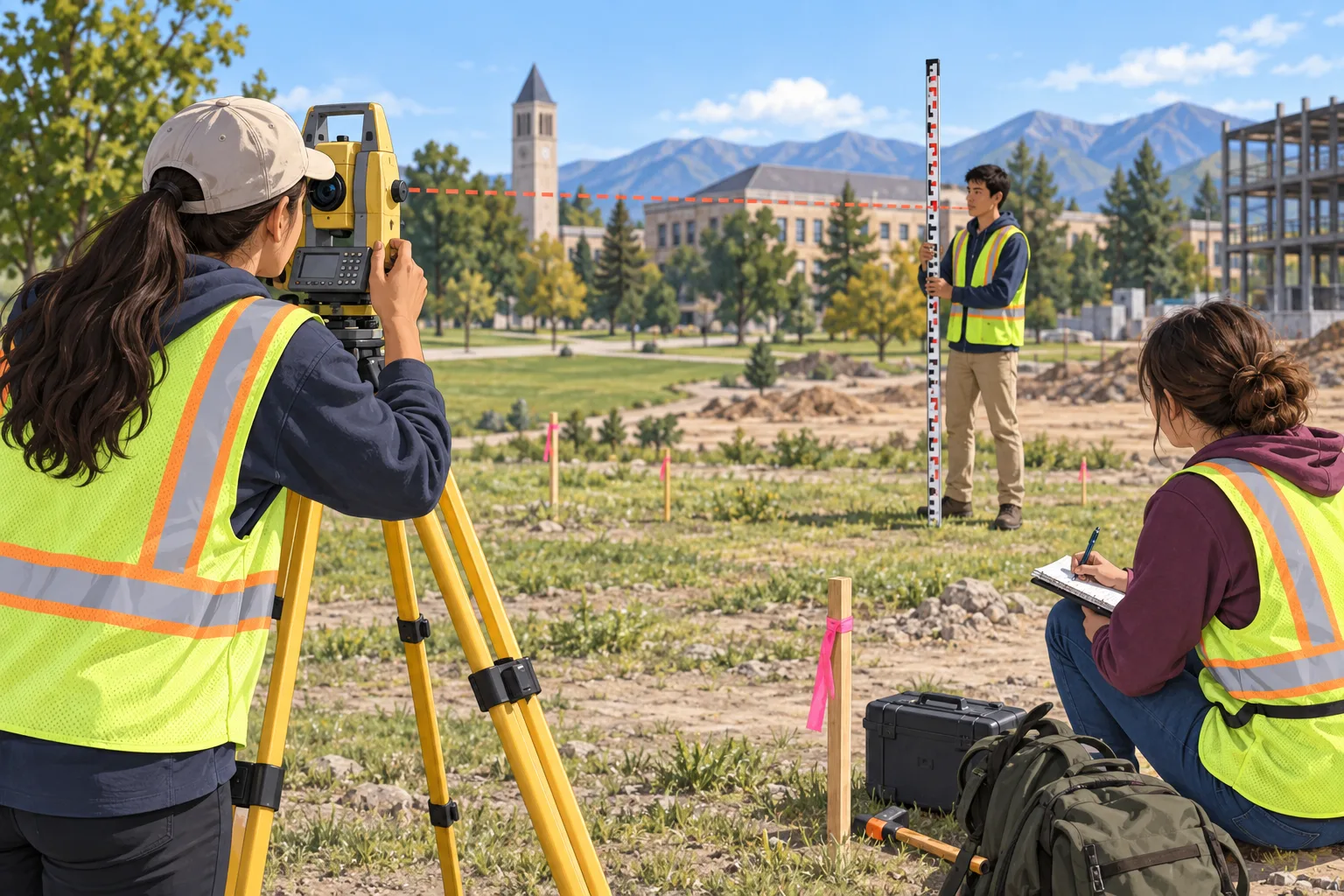
Surveying Field Practice
Connect instrument setup, field observations, closure checks, coordinates, and construction layout; reliable geometry depends on disciplined measurement and verification.
Prerequisite Thinking
Why prerequisites matter
A course prerequisite is not merely an enrollment rule. It identifies knowledge the next course expects you to use fluently.
Geology + Mechanics → Soil Mechanics → Foundation Engineering
Surveying + Geometry + Data Analysis → Highway / Site / Construction Layout Applications
When a student struggles in an advanced subject, the most efficient remedy may be to repair the prerequisite skill rather than repeatedly memorize the advanced formula.
Laboratory Training: Evidence, Not Ritual
Laboratories teach engineers to compare theoretical models with physical behavior. A laboratory result is not automatically "truth": specimens vary, instruments have limitations, procedures introduce uncertainty, and data must be interpreted against applicable standards and specifications.
Examples of laboratory learning
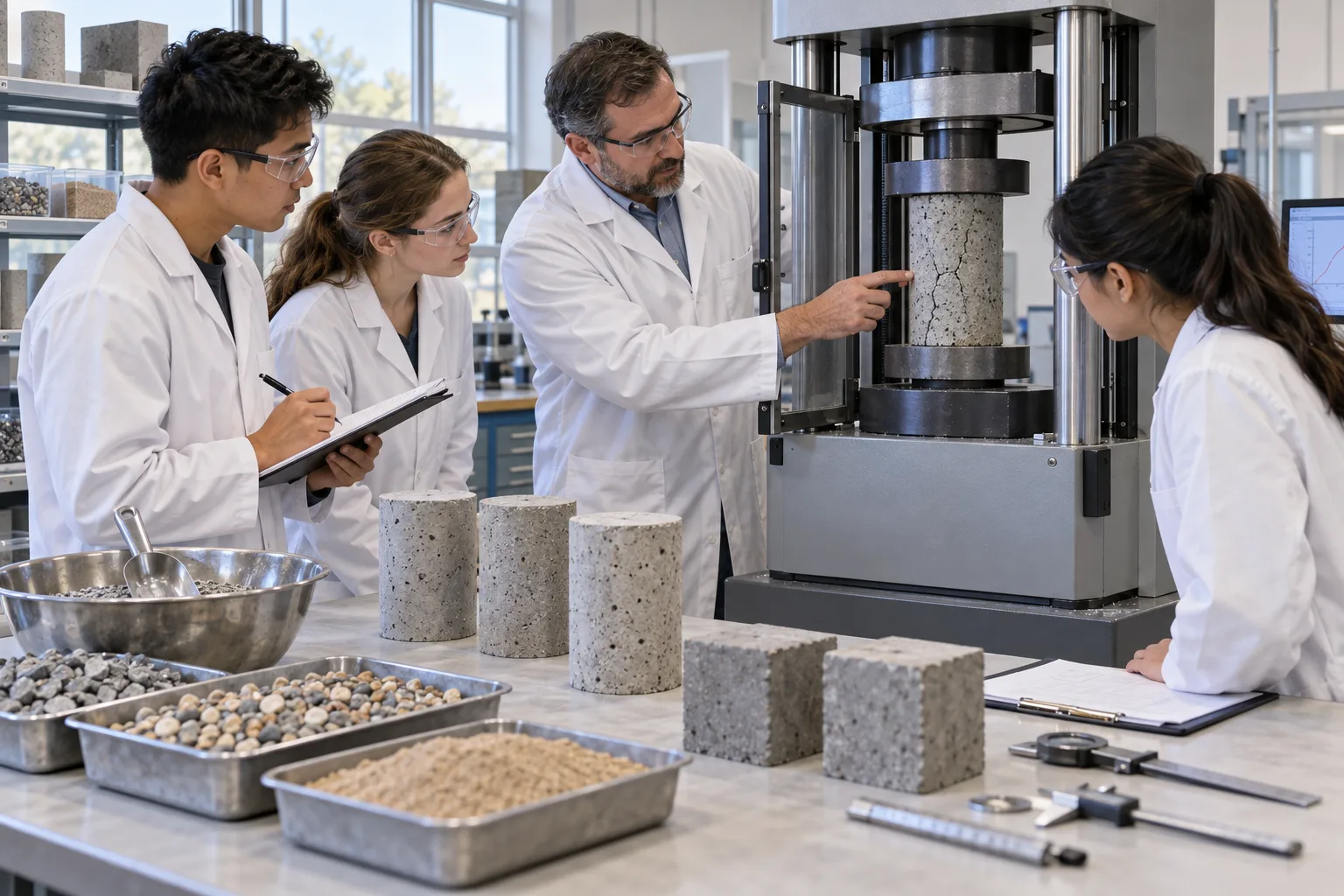
Concrete Testing: Prepare, cure, and test specimens according to the governing test method and project requirements. Different ages may be used for monitoring or acceptance depending on the specification; 28-day strength is common but should not be presented as the only possible acceptance age.
Reinforcing-Steel Testing: Measure properties such as yield behavior, tensile strength, elongation, and other specified characteristics against the applicable material standard and project specification.
Soil Testing: Grain-size distribution, Atterberg limits, compaction, shear strength, consolidation, permeability, and classification support geotechnical interpretation.
Hydraulics Experiments: Weirs, flumes, losses, jets, pipe systems, and open-channel experiments connect measured behavior with idealized fluid models.
Surveying Fieldwork: Measurement, closure, adjustment, coordinates, field notes, instrument setup, error checking, and data reduction develop disciplined observation.
Laboratory Materials Testing
Observe the cycle of specimen preparation, measurement, documentation, and interpretation that turns laboratory work into evidence while preserving uncertainty.
Testing does not remove uncertainty
Engineering tests provide evidence about samples and conditions. A responsible interpretation considers sampling, test method, instrument precision, specimen preparation, variability, acceptance criteria, and whether the sample represents the actual work.
Outcomes-Based Education (OBE)
CHED's quality-assurance framework and engineering curricula use outcomes-oriented approaches. OBE does not guarantee that every student automatically becomes competent; it provides a structured way to define expected capabilities, design learning experiences, assess attainment, and improve the program using evidence.
Outcomes-Based Education
An approach that begins by defining what learners should know and be able to demonstrate, then aligns curriculum, teaching, assessment, and continuous improvement to those intended outcomes.
Program Educational Objectives (PEOs)
PEOs describe broad professional or career achievements the program expects graduates to demonstrate after they have had time to develop in professional life. The exact time horizon and wording are defined by the institution and its program framework; a "3–5 year" period is common but should not be treated as a universal legal definition.
Student Outcomes (SOs)
Student Outcomes describe capabilities students are expected to demonstrate by graduation, such as:
engineering problem analysis;
design under realistic constraints;
experimentation and data interpretation;
communication;
teamwork and leadership;
ethics and professional responsibility;
recognition of societal and environmental effects;
lifelong learning and acquisition of new knowledge.
Continuous improvement loop
Define outcomes → teach and practice → assess evidence → identify gaps → improve curriculum/instruction → reassess
OBE becomes meaningful only when assessment evidence actually informs improvement.
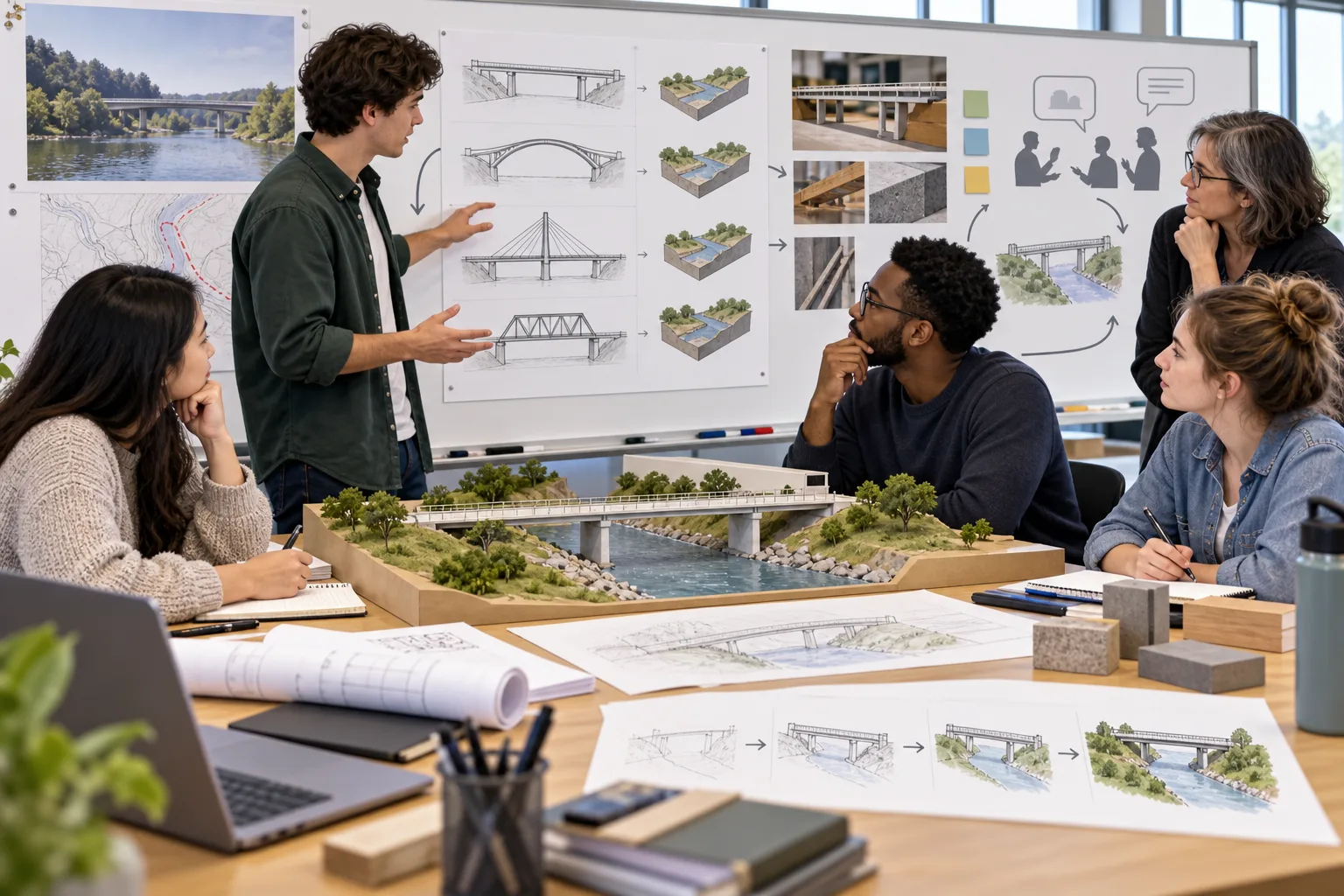
Outcomes-Based Design Studio
See OBE as an evidence loop: students practice and demonstrate capabilities, evaluators assess the evidence, and the results guide improvement.
Fundamental Capabilities vs. Software Skills
Capabilities that should survive a software change
constructing a correct physical model;
drawing and interpreting diagrams;
checking units and dimensions;
estimating order of magnitude;
understanding load paths and boundary conditions;
interpreting uncertainty and variability;
verifying results independently;
reading plans, specifications, standards, and technical reports;
communicating assumptions and limitations.
Digital tools engineers may use
Depending on the role, engineers may work with:
spreadsheets and engineering calculators;
CAD and civil design platforms;
BIM authoring and coordination tools;
structural analysis and design software;
GIS and remote-sensing tools;
project scheduling and cost systems;
Python, MATLAB, or other programming environments;
databases, dashboards, sensors, and data-visualization tools.
Software proficiency is valuable, but software output is not self-validating engineering evidence.
Academic Integrity Is Professional Preparation
The habits used in school become professional habits. Copying a solution without understanding it, fabricating laboratory data, hiding an error, or submitting AI-generated work without verification trains exactly the wrong behaviors for a profession that depends on traceability and public trust.
Examples of academic misconduct
Plagiarism: Presenting another person's words, figures, calculations, code, or ideas as your own without appropriate attribution.
Fabrication: Inventing measurements, laboratory observations, survey data, references, or results that were never obtained.
Falsification: Altering data or procedures to produce a preferred result or concealing inconvenient results.
Unauthorized Collaboration: Sharing work in ways prohibited by the course or submitting group work as individual work.
Unverified AI Use: Submitting generated calculations, citations, reports, code, or explanations without checking their correctness and without following the institution's disclosure rules.
AI can assist; responsibility stays with the student and engineer
AI tools can help explain concepts, generate study questions, summarize notes, or assist with code and writing when permitted. They can also hallucinate references, use incorrect equations, omit assumptions, or produce plausible-looking but unsafe engineering reasoning. Verify every technical claim, calculation, citation, and source before relying on it.
Academic integrity → professional ethics
Fabricating laboratory data can become falsifying material-test reports.
Copying calculations without checking can become signing work you do not understand.
Hiding an error can become concealing a construction or design defect.
Poor citation habits can become intellectual-property and professional-attribution problems.
Professional trust begins with honest student work.
How to Succeed in BSCE
High-value student habits
Repair prerequisite weaknesses early instead of memorizing around them.
Draw a sketch or free-body diagram before selecting equations.
Write units on every important quantity.
Keep an engineering notebook with assumptions, diagrams, calculations, and corrections.
Recalculate representative problems without looking at the solution.
Compare calculator/software output with hand checks and expected physical behavior.
Prepare for laboratories before entering the lab or field.
Learn to read plans and specifications progressively, not only near graduation.
Ask specific questions during consultation or office hours.
Build a portfolio of drawings, analyses, reports, models, research, and projects you can explain.
Practice technical writing and oral communication alongside mathematics.
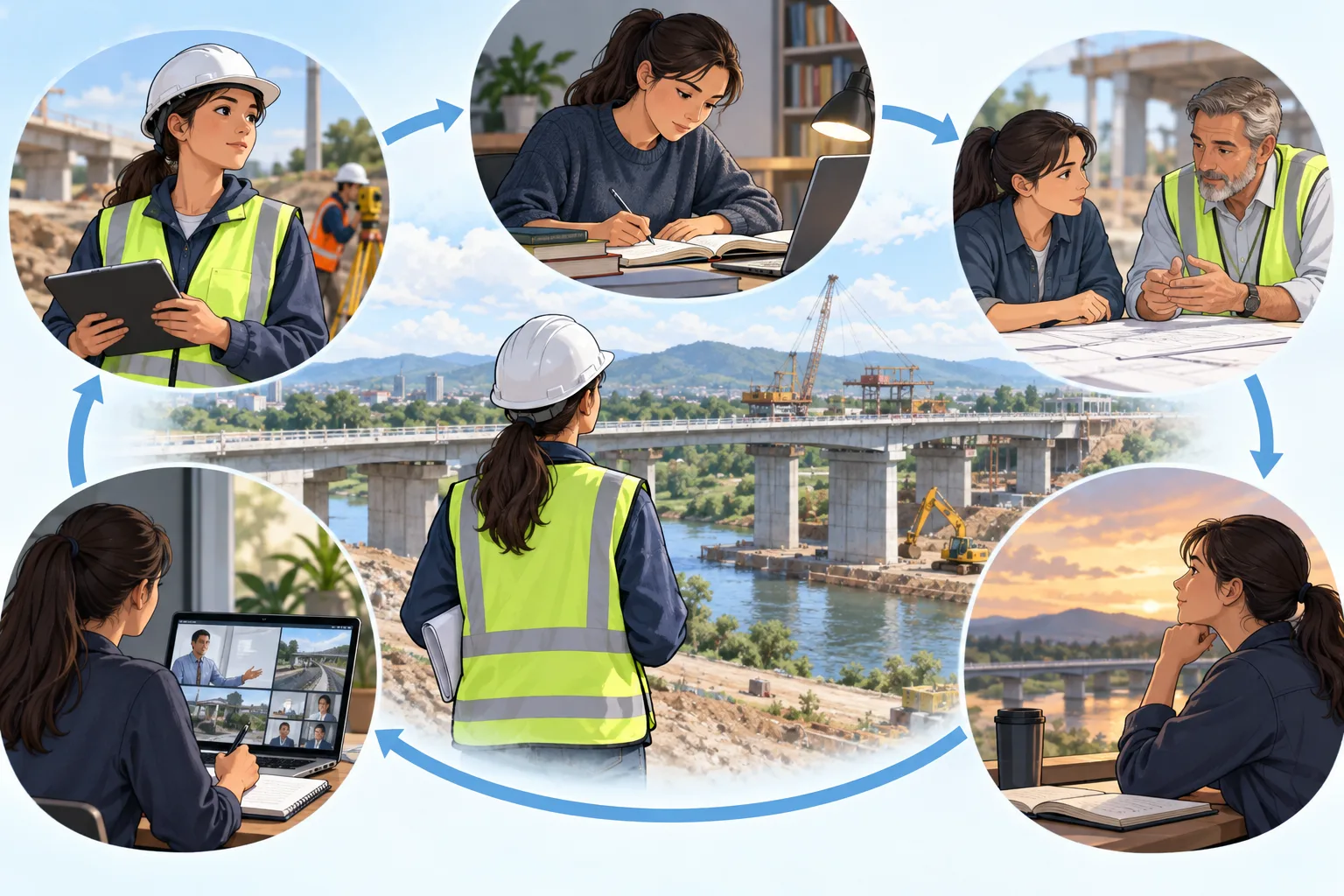
Continuing Professional Development and Lifelong Learning
Graduation and licensure are not the end of engineering education. Republic Act No. 10912, the Continuing Professional Development Act of 2016, establishes the Philippine CPD framework for regulated professions and recognizes formal, nonformal, informal, self-directed, online, and professional-work learning pathways subject to applicable rules.
Examples of continuing development
accredited seminars, workshops, and technical conferences;
graduate education and specialist study;
professional work experience and structured mentoring;
research, publications, presentations, and technical committees;
self-directed study and training subject to current recognition rules;
learning new codes, standards, digital tools, and engineering methods.
Professional Development Loop
Professional competence continues after graduation through structured learning, experience, reflection, and updated practice; CPD is a loop rather than a one-time credential.
Current CPD administrative note — September 2026
PRC has extended acceptance of a CPD undertaking for PIC renewal through 31 December 2026. An undertaking is not a permanent waiver of CPD compliance; current PRC rules should be checked at the time of renewal. This temporary administrative arrangement should not be confused with the underlying lifelong-learning purpose of RA 10912.
Common Misconceptions
Check your assumptions
"The curriculum is the same at every university." False. Institutions implement approved curricula with differences in sequencing, electives, and course design.
"OBE guarantees competence." False. OBE creates an evidence-based framework for defining and assessing outcomes; actual attainment still depends on learning and assessment.
"If software gives an answer, the analysis is correct." False. Incorrect input, modeling, units, assumptions, or interpretation can produce convincing but wrong results.
"Laboratory values are exact material properties." False. Tests contain variability and uncertainty and must be interpreted within the governing method and sampling context.
"Academic integrity is only a school rule." False. It develops the traceability and honesty required in professional engineering practice.
Apply It
Build your personal BSCE dependency map
STEP-BY-STEP
Select one advanced CE subject you expect to take later.
List at least four prerequisite subjects or skills it depends on.
For each prerequisite, write one capability you must retain—not merely one formula.
Identify one laboratory or field activity that supplies evidence for the advanced subject.
Identify one software tool that may assist the work and one independent method you could use to verify its result.
State one academic-integrity rule that would also matter in professional practice.
Content currency
Philippine curriculum, licensure, and CPD requirements can change. This lesson was reviewed on 15 September 2026 against CHED's outcomes-oriented curriculum resources, RA 10912, and current PRC CPD notices. Students should still follow their institution's official curriculum and the latest government issuances.
Key Takeaways
BSCE education is a progressive dependency network connecting math, science, mechanics, computation, laboratories, professional courses, design, communication, and ethics.
Prerequisites matter because advanced courses assume earlier concepts can be used fluently.
Laboratories provide evidence but also teach variability, uncertainty, procedure, documentation, and verification.
OBE defines intended outcomes and uses assessment evidence for continuous improvement; it does not automatically guarantee competence.
Fundamental reasoning, unit discipline, modeling, verification, and communication are more durable than proficiency with any single software package.
Academic integrity is direct preparation for professional engineering responsibility.
RA 10912 establishes CPD as part of continuing competence, while temporary PRC administrative arrangements must be distinguished from the underlying law.
The strongest students learn how to check, explain, document, and defend their engineering reasoning—not merely produce an answer.