Module 4: Torsion

Understanding internal shear forces generated by a twisting moment.
Torsion occurs when a twisting moment or torque is applied to a structural or mechanical member. This module examines the effects of torsion, particularly on circular solid and hollow shafts, which are ubiquitous in mechanical and structural engineering as axles, drive shafts, and structural columns supporting eccentric loads.

Key Concepts

Checklist

Torsion vs Bending

Unlike bending moments which act perpendicular to the longitudinal axis (causing the member to curve and creating normal stresses), a torsional moment acts about the longitudinal axis itself. This twisting action, like wringing out a wet towel, creates internal shear stresses across the cross-section.

Torsion

The twisting of an object due to an applied torque along its longitudinal axis.

Torque

A measure of the turning force that can cause an object to rotate about an axis. It is mathematically the cross product of the position vector (distance from the axis) and the applied force vector. Also known as a twisting moment.

Torsional Shear Stress Formula

Calculating internal shear resistance
When a circular shaft is subjected to a torque (TT), shear stresses develop within the material to resist the twisting. Crucially, in a circular shaft, this shear stress varies linearly from exactly zero at the center of the shaft to an absolute maximum at its extreme outer surface.
The maximum torsional shear stress (τmax\tau_{max}) at the outer fibers is given by the general torsion formula:
τmax=TrJ \tau_{max} = \frac{Tr}{J}
Where:
  • τmax\tau_{max} = Maximum torsional shear stress
  • TT = Applied torque (or twisting moment)
  • rr = Radius of the shaft (distance from center to outer surface)
  • JJ = Polar moment of inertia of the circular cross-section
For a solid circular shaft, the polar moment of inertia (JJ) is a geometric property representing the cross-section's resistance to twisting:
J=πd432orJ=πr42 J = \frac{\pi d^4}{32} \quad or \quad J = \frac{\pi r^4}{2}
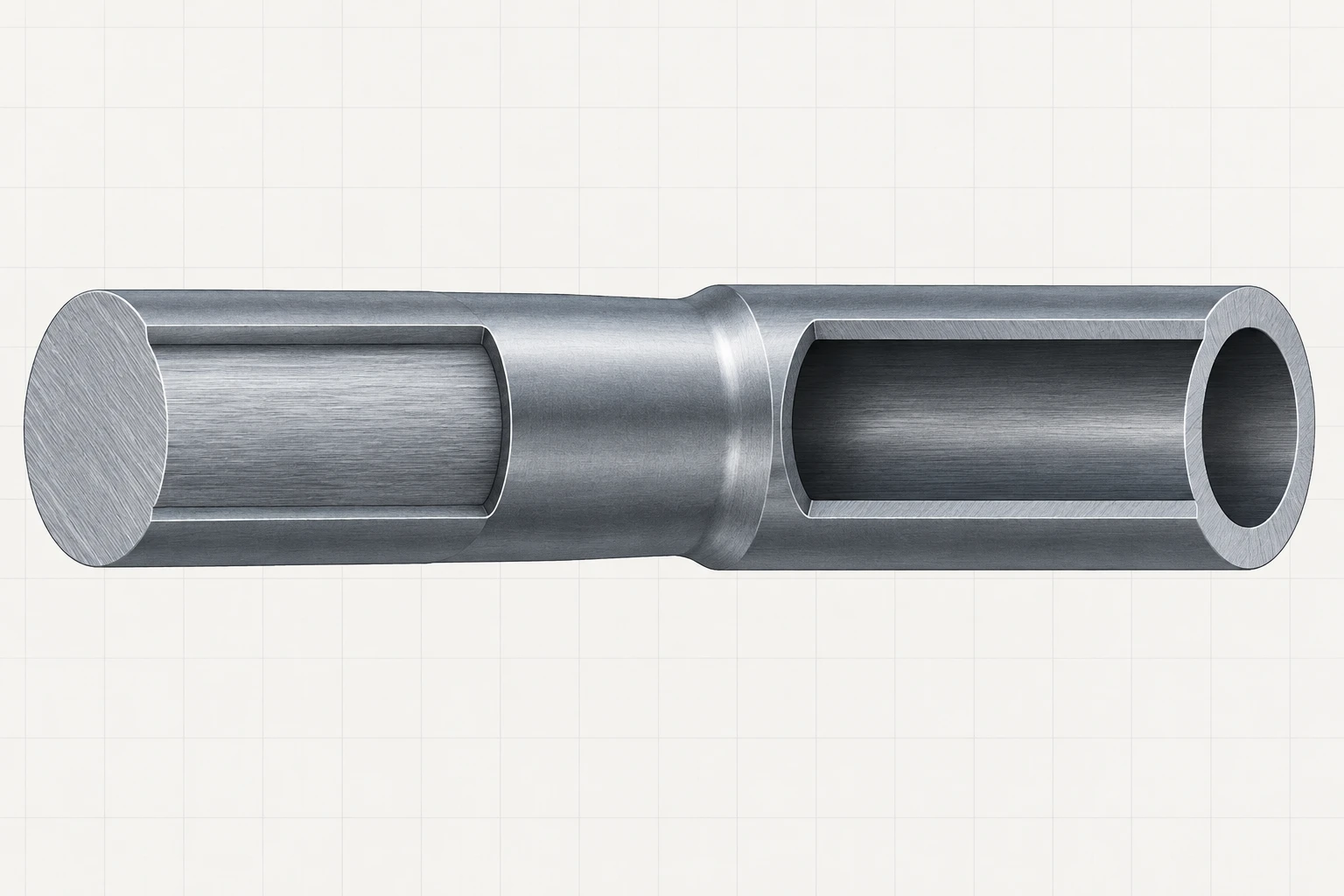
For a hollow circular shaft with outer diameter DD and inner diameter dd, the material in the center (where stress would be lowest anyway) is removed, making it highly efficient. The polar moment of inertia is:
J=π(D4d4)32 J = \frac{\pi (D^4 - d^4)}{32}

Important

The torsion formula (τ=Tr/J\tau = Tr/J) is strictly valid only for linear elastic materials and for shafts with circular cross-sections (either solid or hollow). Non-circular shafts (like square or rectangular bars) experience complex warping under torsion and require advanced mathematical analysis beyond this basic formula.
Key Takeaways
  • Torsional shear stress (τmax=Tr/J\tau_{max} = Tr/J) varies linearly from zero at the center to a maximum at the outer surface of a circular shaft.
  • Hollow shafts are more material-efficient than solid shafts because they remove material from the center where stress is lowest.

Angle of Twist

Angular deformation under torsional load
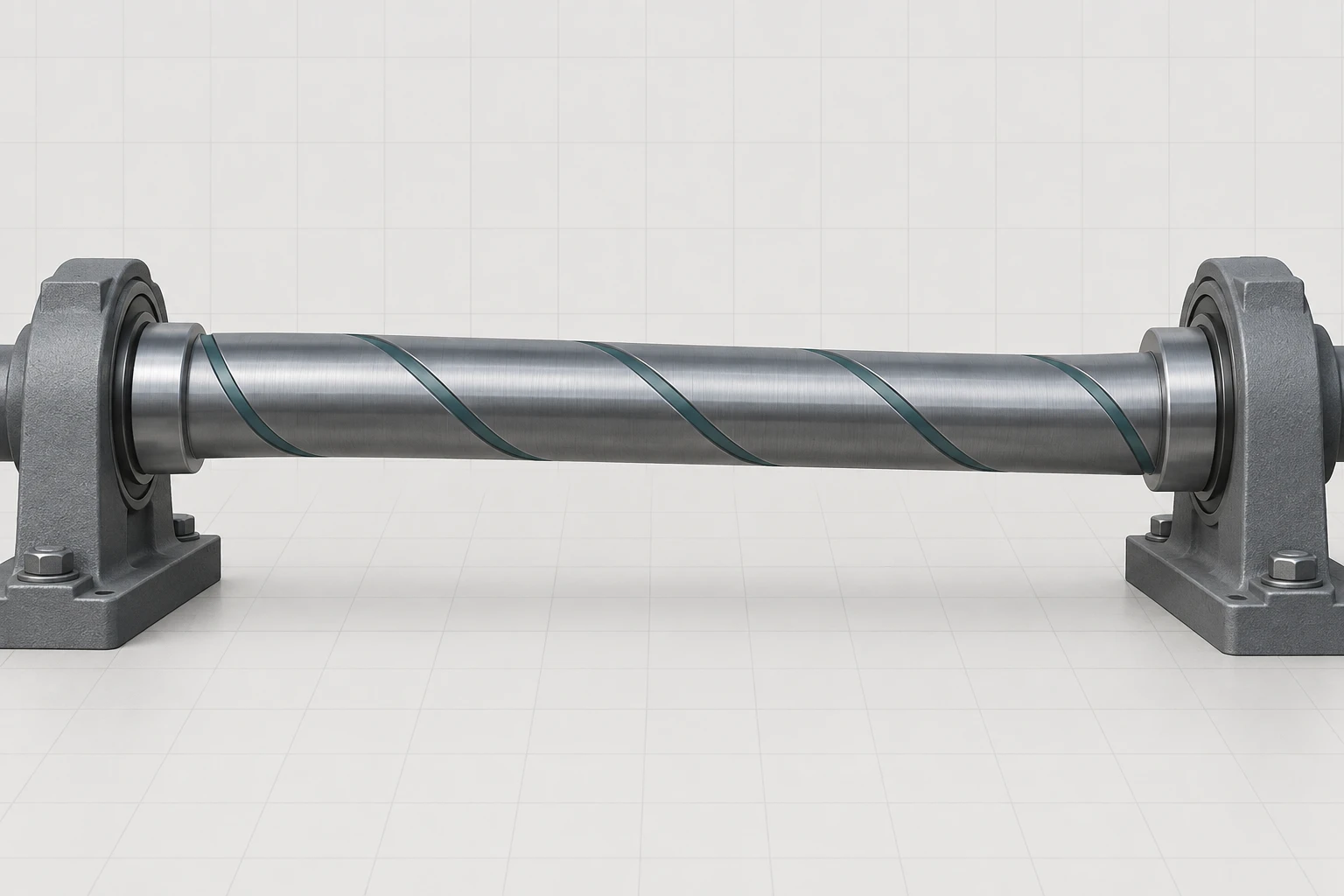
Just as an axial load causes longitudinal deformation (elongation), a torsional load causes angular deformation, known as the angle of twist (θ\theta). This is the angle by which one end of the shaft rotates relative to the other end.
The formula for the angle of twist over a length LL is:
θ=TLJG \theta = \frac{TL}{JG}
Where:
  • θ\theta = Angle of twist (in radians)
  • TT = Applied internal torque
  • LL = Length of the shaft experiencing the torque
  • JJ = Polar moment of inertia
  • GG = Shear modulus of elasticity (Modulus of Rigidity), a material property representing stiffness in shear.

Torsion of a Circular Shaft

T = 1.5 kN·m
The red dashed line represents a longitudinal line on the surface of the shaft before twisting. When torque is applied, the line twists, demonstrating angular deformation.
Max Shear Stress (τmax\tau_{max})
61.1 MPa
Angle of Twist (θ\theta)
3.50°
(0.0611 rad)
Key Takeaways
  • The angle of twist (θ=TL/JG\theta = TL/JG) calculates the rotational deformation of a shaft under torque.
  • Ensure units are consistent (especially keeping torque in NmmN\cdot mm and lengths in mmmm) to get the angle in radians.

Advanced Torsional Scenarios

Flanged bolt couplings and thin-walled tubes
Beyond standard solid and hollow circular shafts, engineers frequently encounter complex torsional scenarios in practical design. Two highly common applications are flanged bolt couplings (used to connect two separate shafts) and thin-walled tubes.

Flanged Bolt Couplings

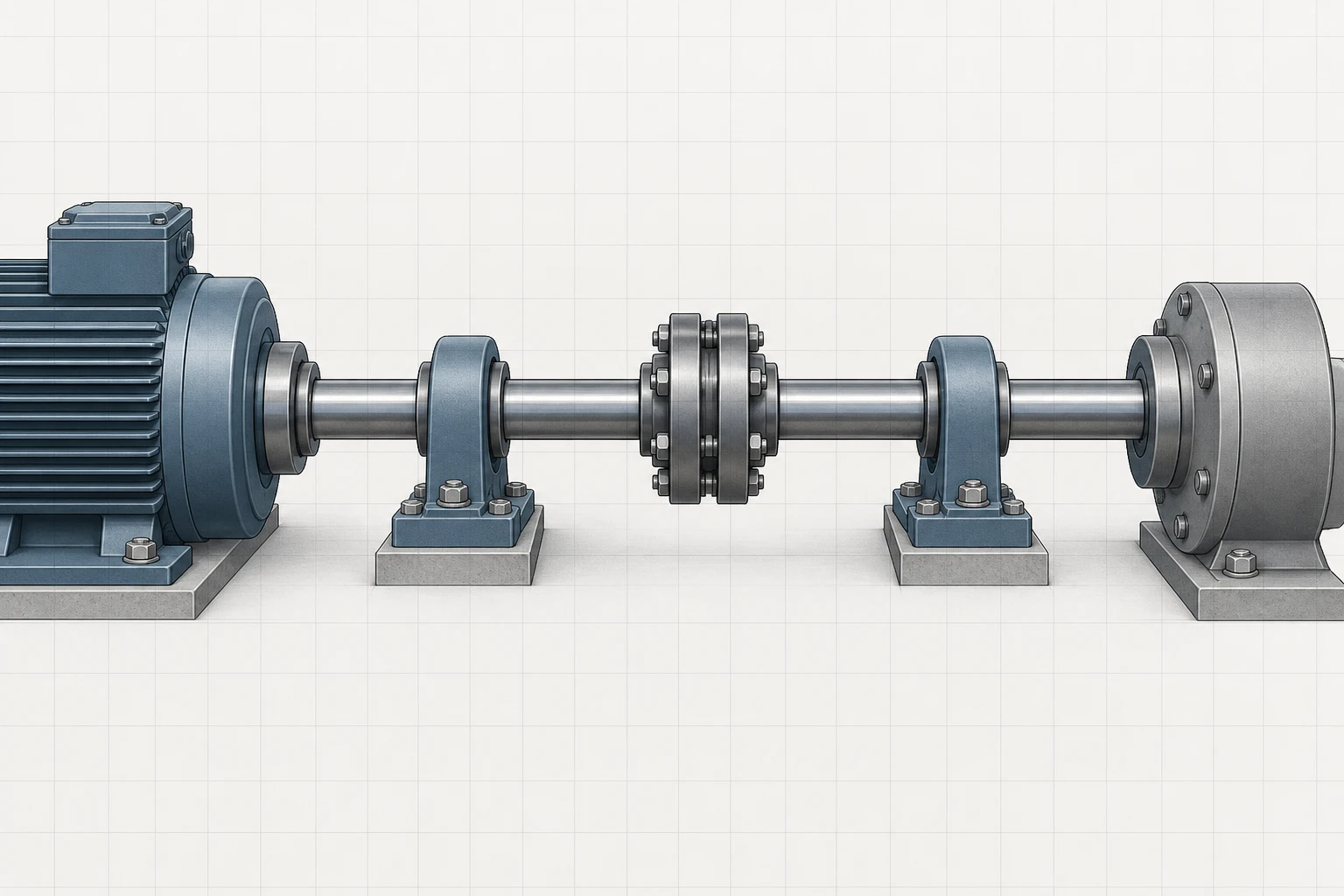
When two shafts are connected end-to-end via a bolted flange, the entire torsional moment is transmitted from one shaft to the other entirely through the shear resistance of the bolts.
If nn is the total number of bolts, AbA_b is the cross-sectional area of one bolt, dd is the bolt diameter, RR is the radius of the bolt circle (the distance from the center of the shaft to the center of the bolts), and τ\tau is the allowable shear stress in the bolts, the maximum torque that the coupling can safely transmit is governed by:
T=(nAbτ)R T = (n \cdot A_b \cdot \tau) \cdot R
This is simply stating that Torque = (Total Shear Force Resisted by all Bolts) ×\times (Lever Arm from Center).

Torsion of Thin-Walled Tubes

When a twisting moment is applied to a non-circular thin-walled tube (like a rectangular aluminum extrusion or a closed steel box section), the shear stress is no longer distributed linearly from the center as it is in a solid circular shaft. Instead, it is distributed as a uniform shear flow (qq) traveling around the perimeter of the cross-section.
The relationship between the applied torque TT and the shear flow qq is defined by Bredt's formula:
T=2Aenclosedq T = 2 \cdot A_{enclosed} \cdot q
Where:
  • AenclosedA_{enclosed} = The geometric area enclosed by the centerline of the thin wall (not the material area itself).
Since shear flow q=τtq = \tau \cdot t (where tt is the wall thickness at any point), the average shear stress at any specific point along the perimeter is:
τ=T2tAenclosed \tau = \frac{T}{2 \cdot t \cdot A_{enclosed}}

Important

In a thin-walled tube under torsion, the maximum shear stress always occurs exactly where the wall thickness tt is the thinnest, because the shear flow qq is constant throughout the entire perimeter.
Key Takeaways
  • In flanged bolt couplings, torque is transmitted through the combined shear resistance of the bolts acting at a distance RR from the center.
  • For thin-walled tubes, torsion creates a constant shear flow qq around the perimeter.
  • Bredt's formula (T=2AenclosedτtT = 2 A_{enclosed} \tau t) dictates that the highest shear stress occurs where the wall is thinnest.

Power Transmission

Relating torque, speed, and power
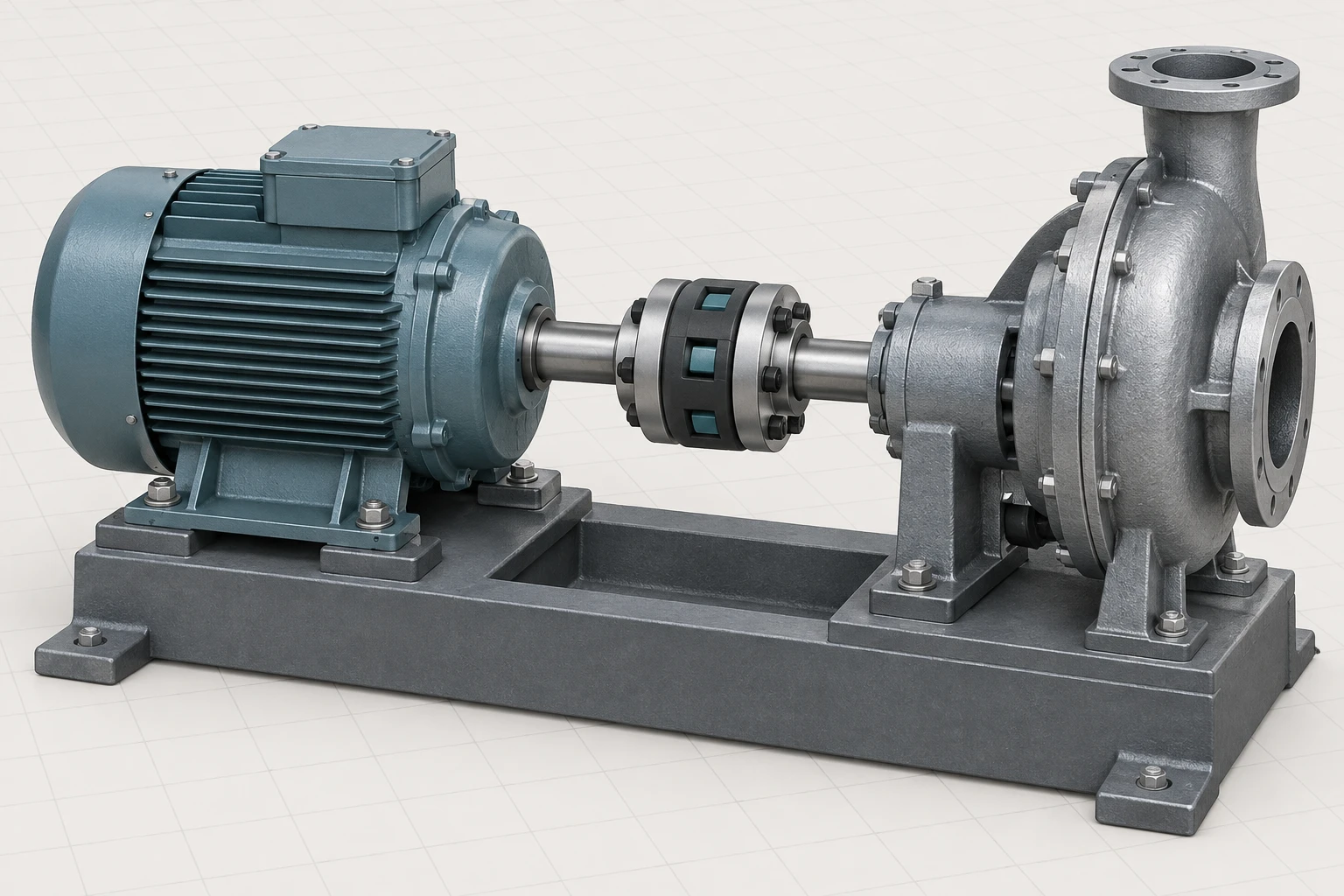
Circular shafts are widely used in mechanical engineering to transmit power from a motor to a machine. The fundamental physical relationship between mechanical power (PP), applied torque (TT), and rotational speed (ω\omega or NN) is:
P=Tω P = T \omega
Where angular velocity ω\omega (in radians per second) is related to rotational speed NN (in revolutions per minute, RPM) by ω=2πN60\omega = \frac{2\pi N}{60}.
Substituting ω\omega into the power equation yields the common engineering formula:
P=2πNT60 P = \frac{2\pi N T}{60}
Where:
  • PP = Power transmitted (Watts, W or Joules/second)
  • NN = Rotational speed in revolutions per minute (RPM)
  • TT = Torque in NmN\cdot m
Key Takeaways
  • Power transmitted by a shaft relates to torque and rotational speed via P=2πNT/60P = 2\pi N T / 60.
  • Ensure torque is derived correctly before plugging it into the general torsion formula for stress calculations.

Helical Springs

Combining torsion and direct shear in coiled members
A closely coiled helical spring subjected to an axial load (PP) behaves fundamentally as a torsional member. The wire forming the spring experiences a twisting moment as the coils try to flatten out under the load.
The maximum shear stress (τmax\tau_{max}) in a helical spring is a combination of direct shear stress and torsional shear stress. To accurately calculate this, we use Wahl's formula, which introduces a correction factor (KWK_W) to account for the curvature of the inner face of the coil.
τmax=8PDπd3KW \tau_{max} = \frac{8 P D}{\pi d^3} K_W
Where:
  • PP = Axial load on the spring
  • DD = Mean diameter of the spring coil
  • dd = Diameter of the spring wire
  • KWK_W = Wahl's Correction Factor (depends on the spring index, C=D/dC = D/d)

Spring Index (C)

The ratio of the mean coil diameter (DD) to the wire diameter (dd), defined as C=D/dC = D/d. It is a measure of coil curvature.
The deflection (δ\delta) of a closely coiled helical spring under an axial load PP with nn active coils is given by:
δ=8PD3nGd4 \delta = \frac{8 P D^3 n}{G d^4}
Where:
  • nn = Number of active coils
  • GG = Modulus of Rigidity (Shear Modulus) of the spring material
Key Takeaways
  • Helical springs resist axial loads primarily through torsional shear in the wire.
  • Wahl's formula (τmax=8PDπd3KW\tau_{max} = \frac{8 P D}{\pi d^3} K_W) calculates the maximum shear stress, factoring in direct shear and coil curvature.
  • Spring deflection depends on the cube of the coil diameter and inversely on the fourth power of the wire diameter (δ=8PD3nGd4\delta = \frac{8 P D^3 n}{G d^4}).

Statically Indeterminate Torsion Members

Solving systems with unknown torques

Indeterminate Torques

A torsional member is statically indeterminate when the internal torques cannot be determined using the equations of static equilibrium alone (T=0\sum T = 0). This typically occurs when a shaft is fixed at both ends and subjected to intermediate torques, or when a shaft is composed of two different materials bonded together.
To solve these systems, compatibility equations based on deformation (angle of twist) must be formulated. For example, if a shaft is fixed at both ends, the total angle of twist from one end to the other must be zero: θ=0\sum \theta = 0. By combining equilibrium equations with compatibility equations, the unknown internal torques can be found.
Key Takeaways
  • Statically indeterminate torsional systems require deformation compatibility equations in addition to static equilibrium.
  • A common compatibility condition is that the total angle of twist between two fixed supports is zero (θ=0\sum \theta = 0).